Elderflower Pancake
Bärbel Heumann
- sweet
- foraging
- Germany
Our first cooking show in the forest during our residency in zusammen (er)leben June 2021.
Bärbel, who’s like a mother to me, showed me how to make Holunder Köcheln, blossomy pancake that pairs well with strawberries and lemon zest. June is the perfect time to collect them. Make a batter, dip them in and fry.
This is a rough recipe for a batter
Everything is adaptable and made to taste
Follow ur flow
Foraged footages from:
Lindau am Bodensee, June 2021
Berlin, June 2022
Lisbon, June 2023
Bärbel Heumann ich hab dich lieb
Video by gal sherizly
A Quiet Revolution in a Jar
Edit Hunyadi
- fermentation
- East-European
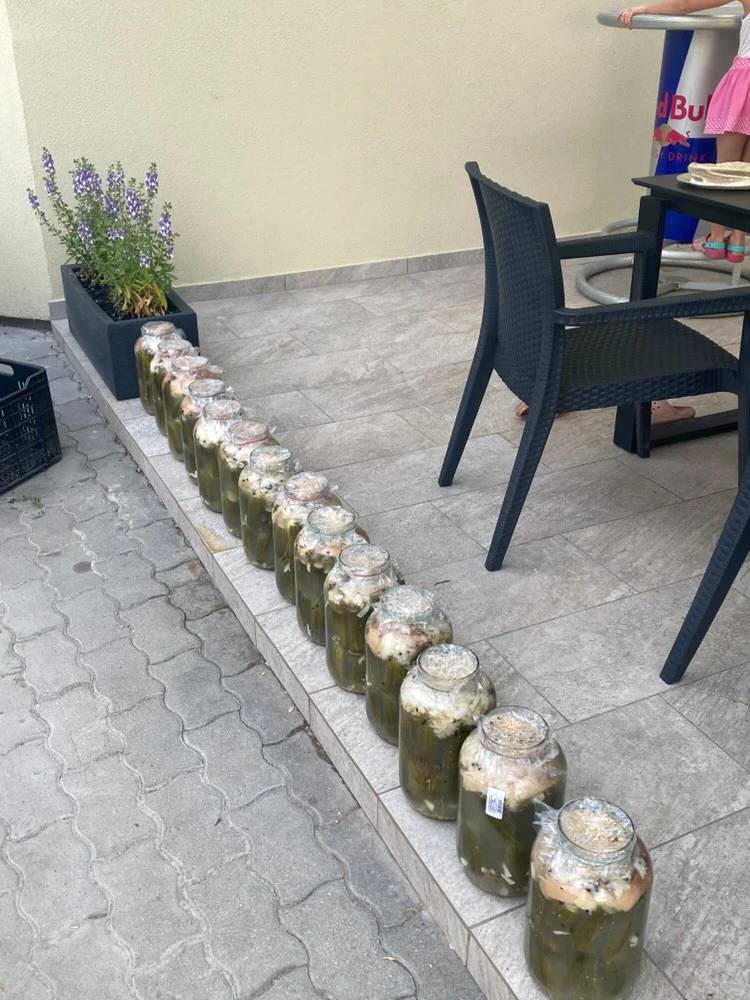
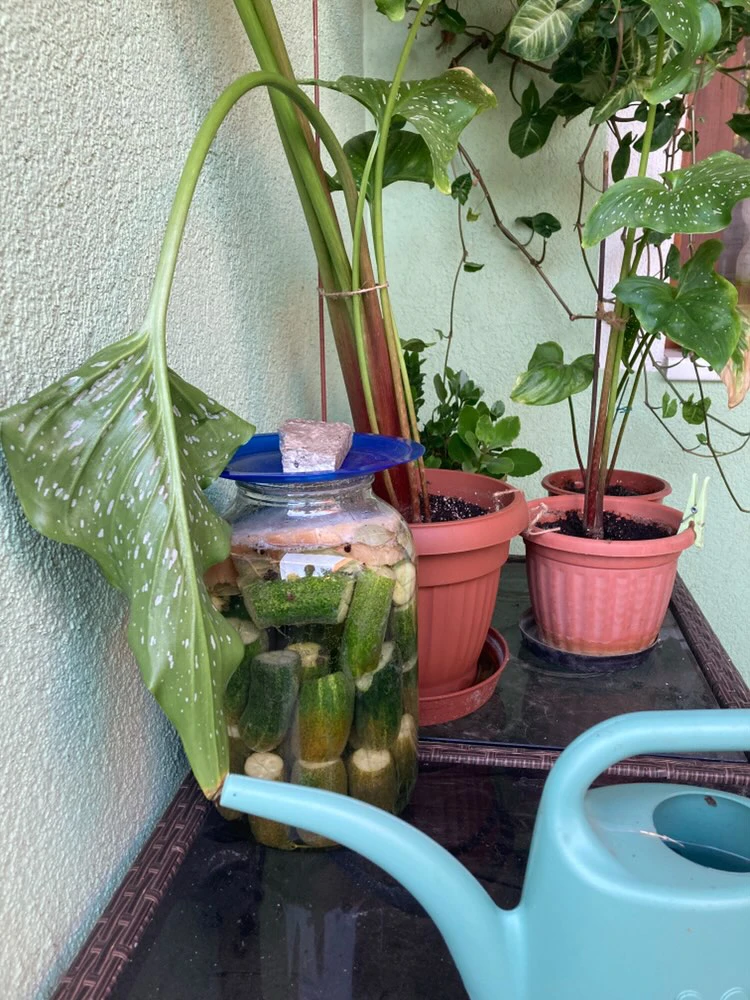
This summer, I was walking towards the beach at Dunasziget, a small village near the Hungarian-Slovakian-Austrian border, next to the Danube. Like every proper beach in Hungary, there was a büfé—a small snack bar with the typical fast-food offerings. But what caught my eye wasn’t the food. In front of the snack bar was a long row of jars of kovászos uborka, fermented cucumbers—a common summer staple in many Hungarian households. The sight of those jars immediately took me back to my childhood, standing in our garden, watching my mom meticulously clean cucumbers with a dedicated brush before packing them into large jars with fresh dill, filling them with salty brine, and topping it all with a slice of bread. This was the start of a slow, deliberate process—the kind that takes days under the hot summer sun.
As I stood there, admiring those jars of cucumbers quietly soaking in the sun, my 8-year-old nephew zoomed past, demanding a bottle of Coca-Cola like it was the elixir of life. It struck me then: while I was contemplating slow fermentation, he was racing toward an instant sugar fix. Quite the culinary culture clash.
This moment reminded me of Lacan's theory of desire. Lacan, a French psychoanalyst, argued that human desire is never fully satisfied. It’s not about wanting something specific; it’s about wanting itself. Watching my nephew cry for his Coca-Cola, I realized that, like him, we often crave the chase more than the thing itself. He was convinced the sugary drink would satisfy him (and indeed, maybe it would), but Lacan would argue it’s the excitement of wanting that truly drives us.
Capitalism thrives on this chase, selling us products with the promise of fulfillment, only to keep us wanting more. Fermentation, on the other hand, asks us to wait, to slow down—something capitalism doesn’t particularly encourage. Unlike a Coke, fermentation isn’t fast or flashy; it’s slow, deliberate, and anti-capitalist by nature.
But as much as fermentation resists capitalist speed, Nancy Fraser’s critique shows us that capitalism devalues the invisible labor behind traditions like these. As I watch my mom—or the women at the büfé—tend to their jars of cucumbers, I see how this labor is essential for preserving culture. But since it doesn’t generate profit, it’s overlooked. Fraser calls this cultural misrecognition: the way traditions are ignored because they can’t be easily commodified.
For Fraser, justice isn’t just about recognizing cultural work, it’s about valuing the labor that sustains it. Watching my mom spend hours perfecting these cucumbers makes it clear this isn’t just a hobby; it’s labor—labor that doesn’t get a paycheck but keeps traditions alive. In making these cucumbers, I’m not just preserving food; I’m quietly resisting a system that devalues this kind of work.
In many ways, Fraser’s critique and Lacan’s analysis intersect. Capitalism exploits our endless desire for more, but it also overlooks the labor that doesn’t directly generate profit. Each time I follow my mom’s recipe, it feels like reclaiming something personal and cultural—stepping outside the capitalist drive for instant gratification.
I don’t expect fermented cucumbers to fulfill my desires—and yes, I still enjoy a cold Coca-Cola now and then. But these cucumbers were a good reminder of something deeper: the desire capitalism exploits can be resisted. In the slow, deliberate process of fermentation, I find not just a quiet defiance against consumerism but a recognition of the invisible labor that sustains traditions and communities. And in that slowness, there’s a quiet feminist revolution. Now, here’s my mom’s take on how to ferment desire—one cucumber at a time.
Kovászos Uborka (Fermented Cucumbers):
Ingredients:
2 kg small cucumbers (approximately, depends on how tight you pack the jar)
1 tablespoon vinegar
3 tablespoons salt (for a 5-liter jar)
Peppercorns
1 bay leaf
Lukewarm water
Instructions:
Place a layer of fresh dill at the bottom of the jar.
Wash the cucumbers and make a few small cuts into each one.
Pack the cucumbers tightly into the jar.
Pour lukewarm salty water over the cucumbers until they’re fully submerged. Add the peppercorns and bay leaf, then place a slice of bread on top.
Loosely cover the jar and leave it in the sun for 3-4 days.
After 3-4 days, taste the cucumbers. Once they’re ready, strain the liquid, rinse each cucumber individually, place them in a new container with the strained brine, and refrigerate.
The 4x4 Cake
Le Quatre Quarts de Mamie, Maman, Martine et Moi
Florence Freitag
- sweet
- France
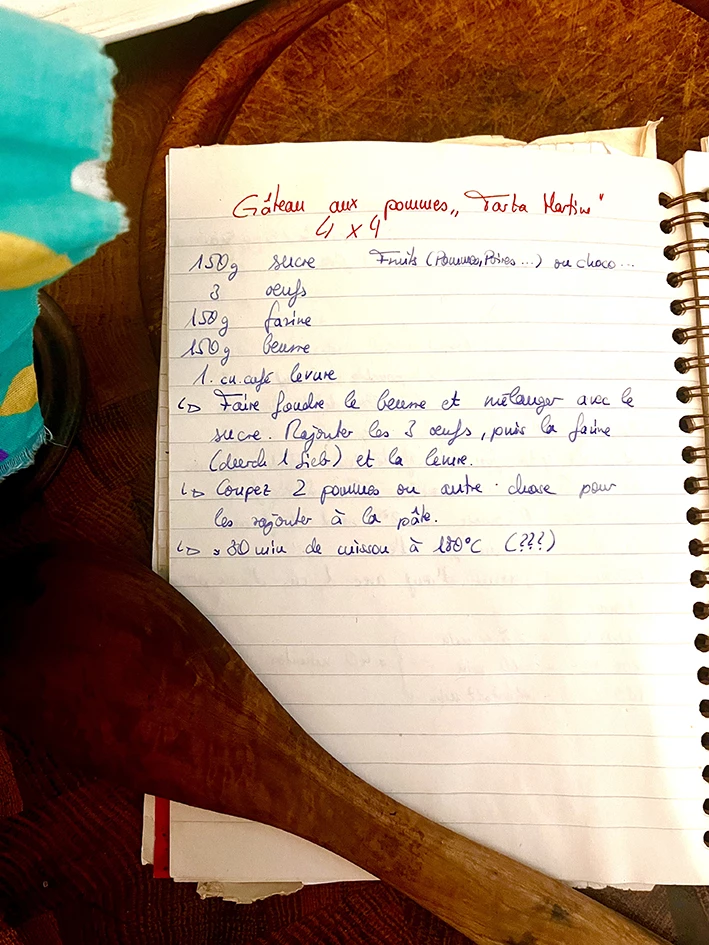
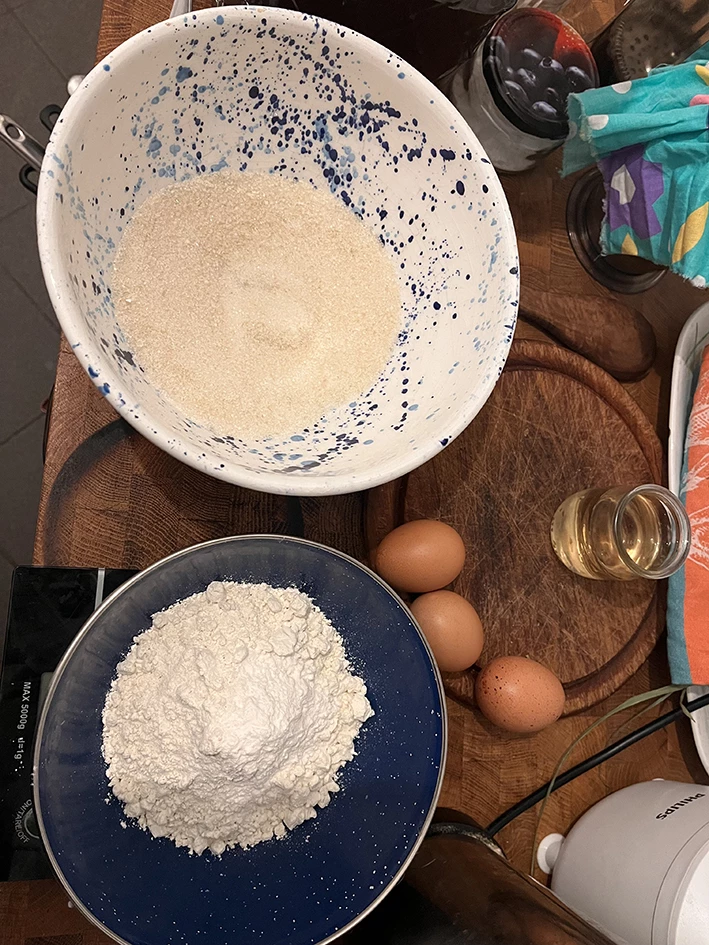
I started this little recipe research by looking through old photos to find a version of it that I made some years ago. I didn’t find it, but instead endless pictures of loved ones and memories, reminding me of change, transformation and time passing in a strange way. Food also works like a container for those memories. I cried over seeing the pictures and then decided to let it drip into a fresh 4x4 that I’d try before writing down the steps again and translating the recipe I got from my french aunt.
My aunt's 4x4 is not really hers, but I associate it with her, Martine; as between my grandma, my mum and me, she did it best. My aunt died 11 years ago (it doesn’t feel like that long ago), way too early and through circumstances that still equally enrage and sadden me. Martine also was one of my queer ancestors that I never got to talk to about her queerness, cause it wasn’t something she could live in her lifetime. Anyway, this is what I think about when I bake her cake and it’s kinda soothing that the ingredients hold these precious thoughts in easily memorizeable measurements:
4x4 or Tata Martine’s (Apple) Cake
150g sugar
3 eggs
150g flour (I have done it equally with wheat flour, spelt and could imagine buckwheat/corn/rice as well, but haven’t tried a gf version yet)
150g butter (same here, plant butter works)
1 teaspoon of baking powder
Optional: Apples, Pears or another fruit of choice
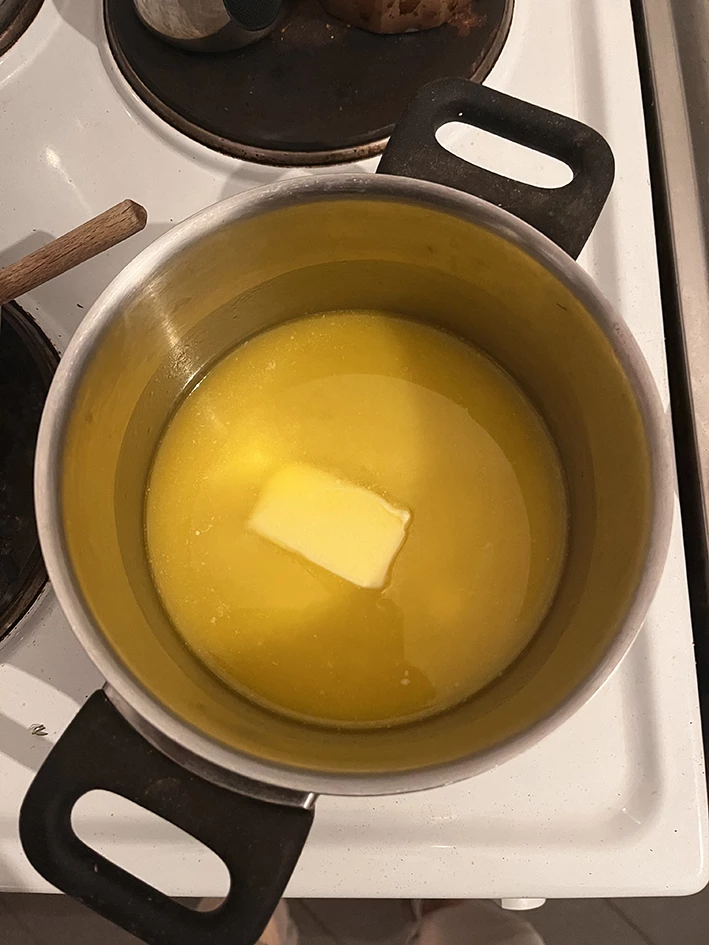
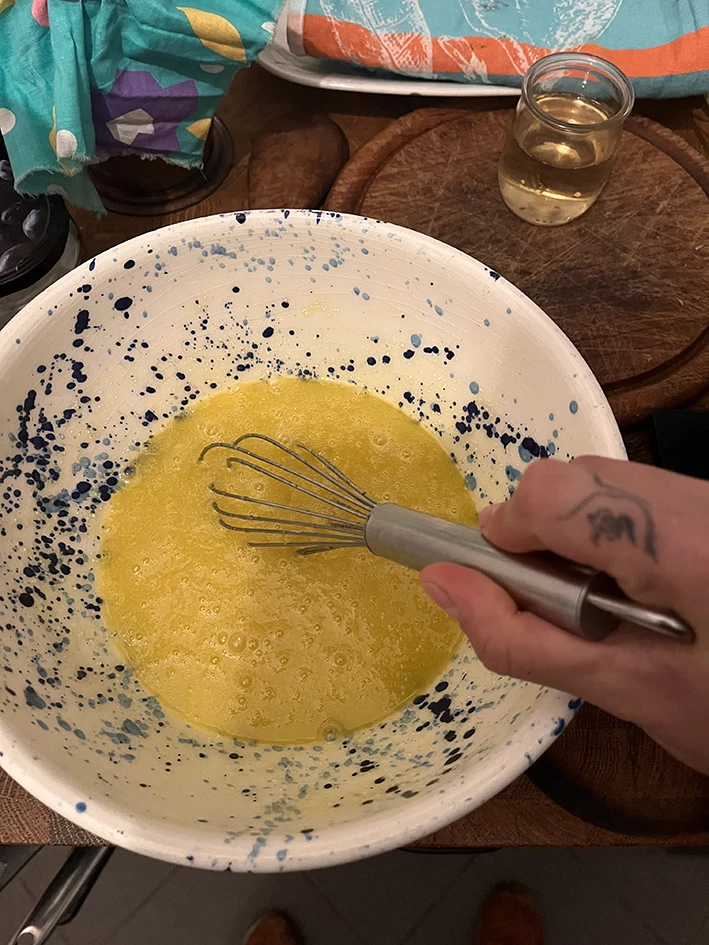
→ Melt the butter and mix it with the sugar in a separate bowl
→ Add in the 3 eggs and whisk it
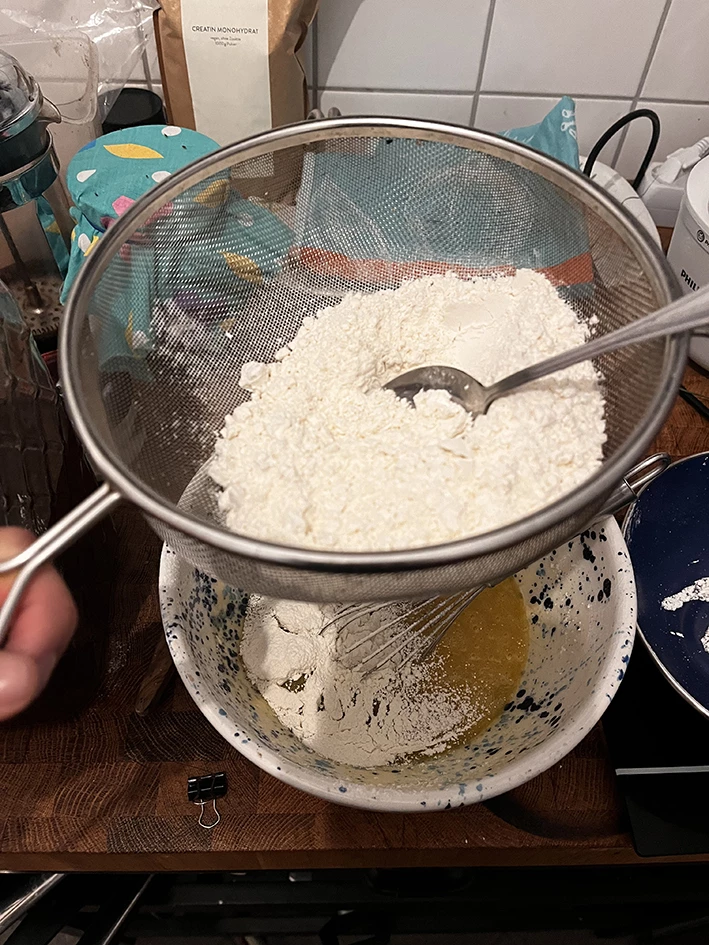
→ Add the flour and baking powder through a sieve (if you have patience, it makes a difference in smoothness)
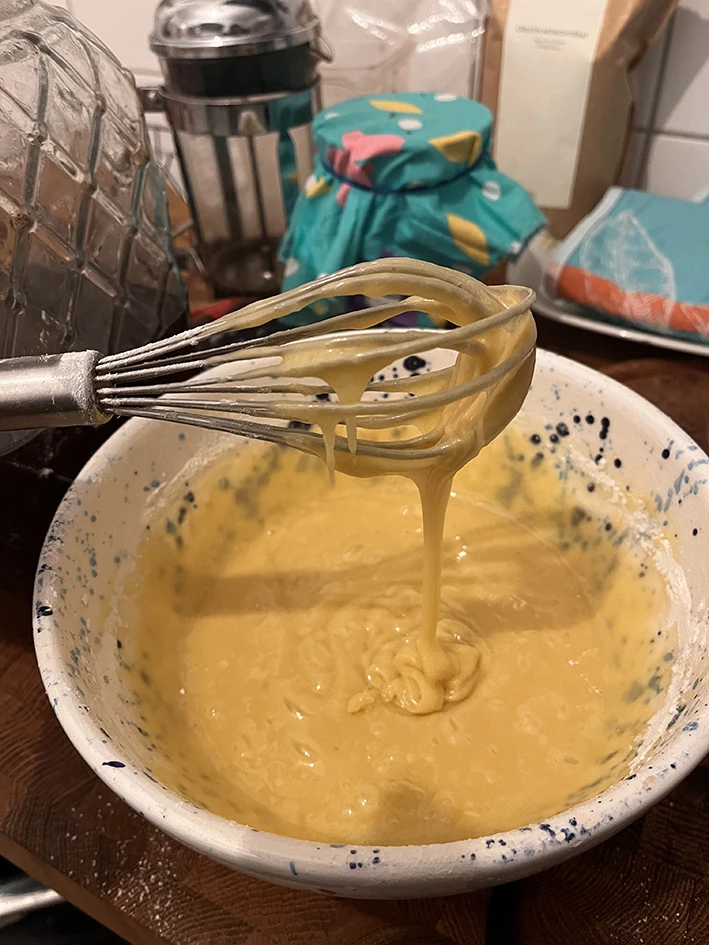
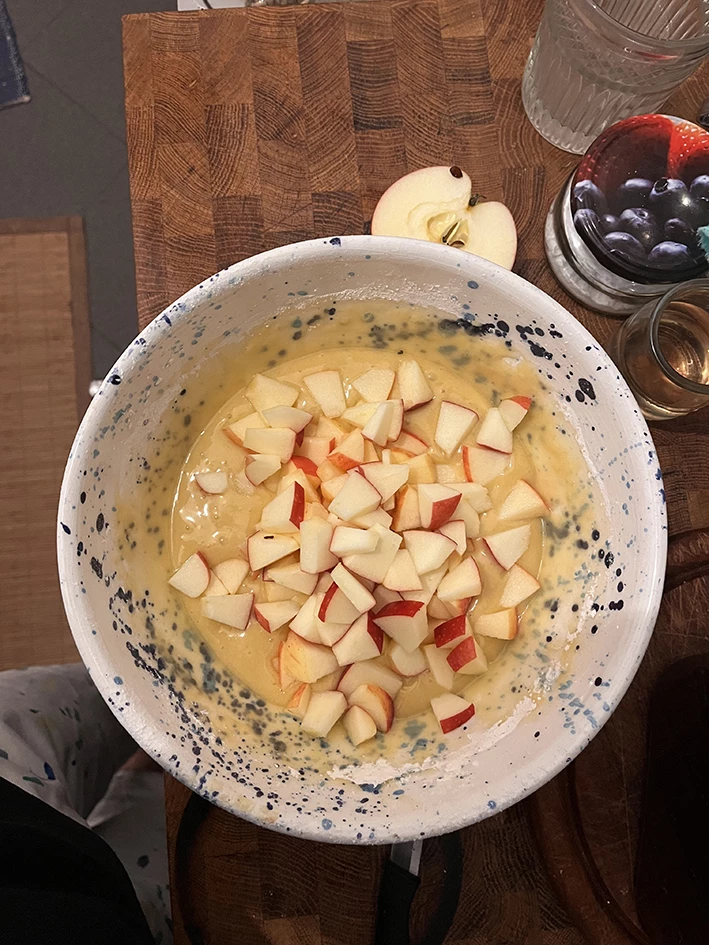
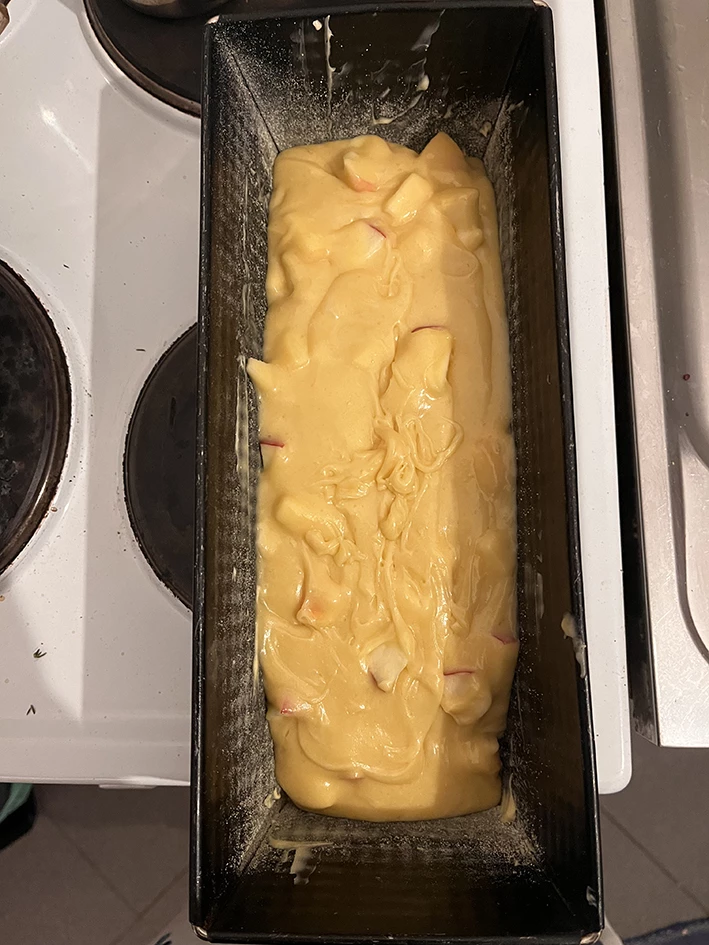
→ Cut 2 apples into cubes and add it to the moist batter
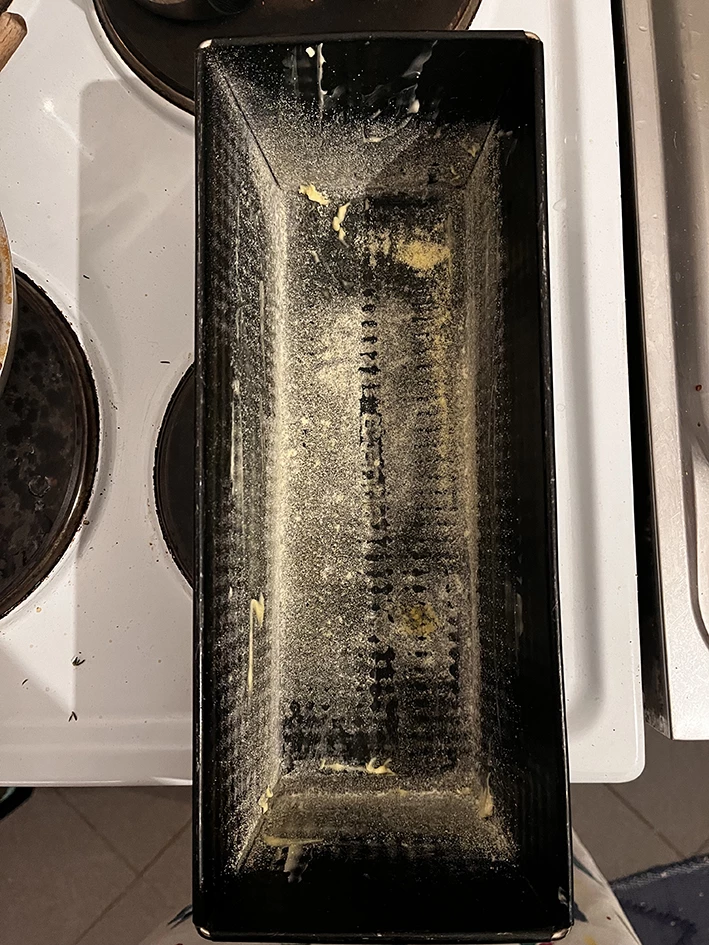
→ Grease a square baking pan (mine on the pictures was slightly too long) and scatter flour on top for the cake not to stick
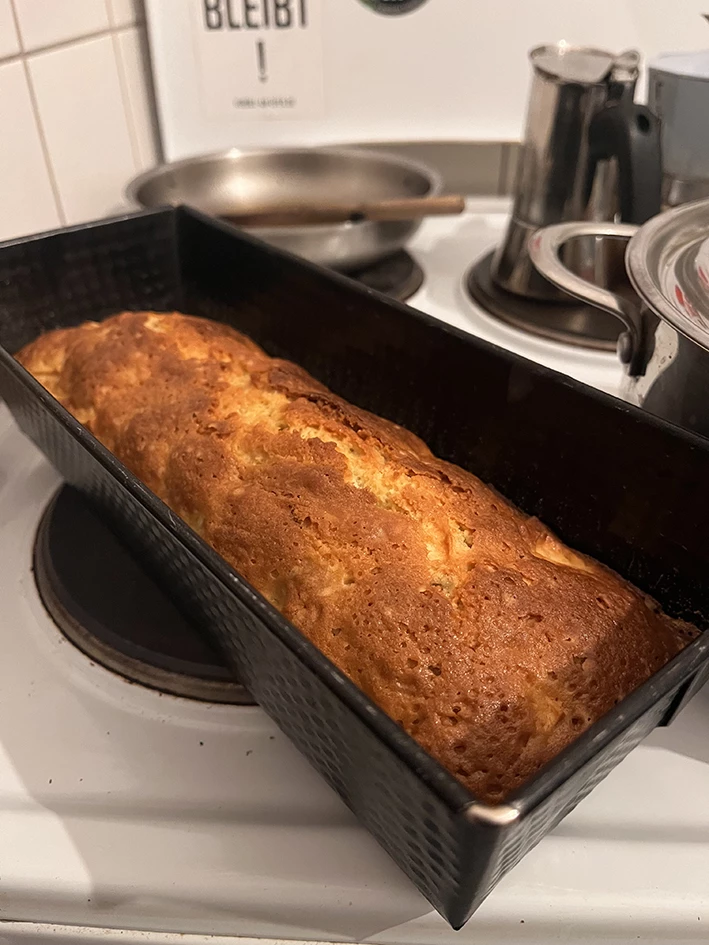
→ Bake for approx 45-50 minutes at 180° (check with a knife its not humid anymore)
While baking the cake I wrote text messages with my mum, whom I had asked to bake one as well. Unfortunately she couldn’t, as she was taking care of my grandma, but she googled the recipe out of curiosity and found one where the author tried to do the math. It doesn’t really matter but the funny thing is that the person was called „Florence“, that’s my birth name, too:
1. (Florence) » Si on additionne quatre quarts, cela fait combien? »
2. (sourire du petit gourmand) « Un gâteau! Miam »
3. (Florence) « Euh, si tu ajoutes un quart à un quart, combien cela fait? »
4. (Mari) « Une pinte ! »
Bon Appétit <3
A Tofutopian Ritual
HE Shen 何珅, Vanessa Bosch วาเนสซ่า and NI Daodao 倪岛岛
- tofu
- diaspora
- China
- Thailand
- Switzerland
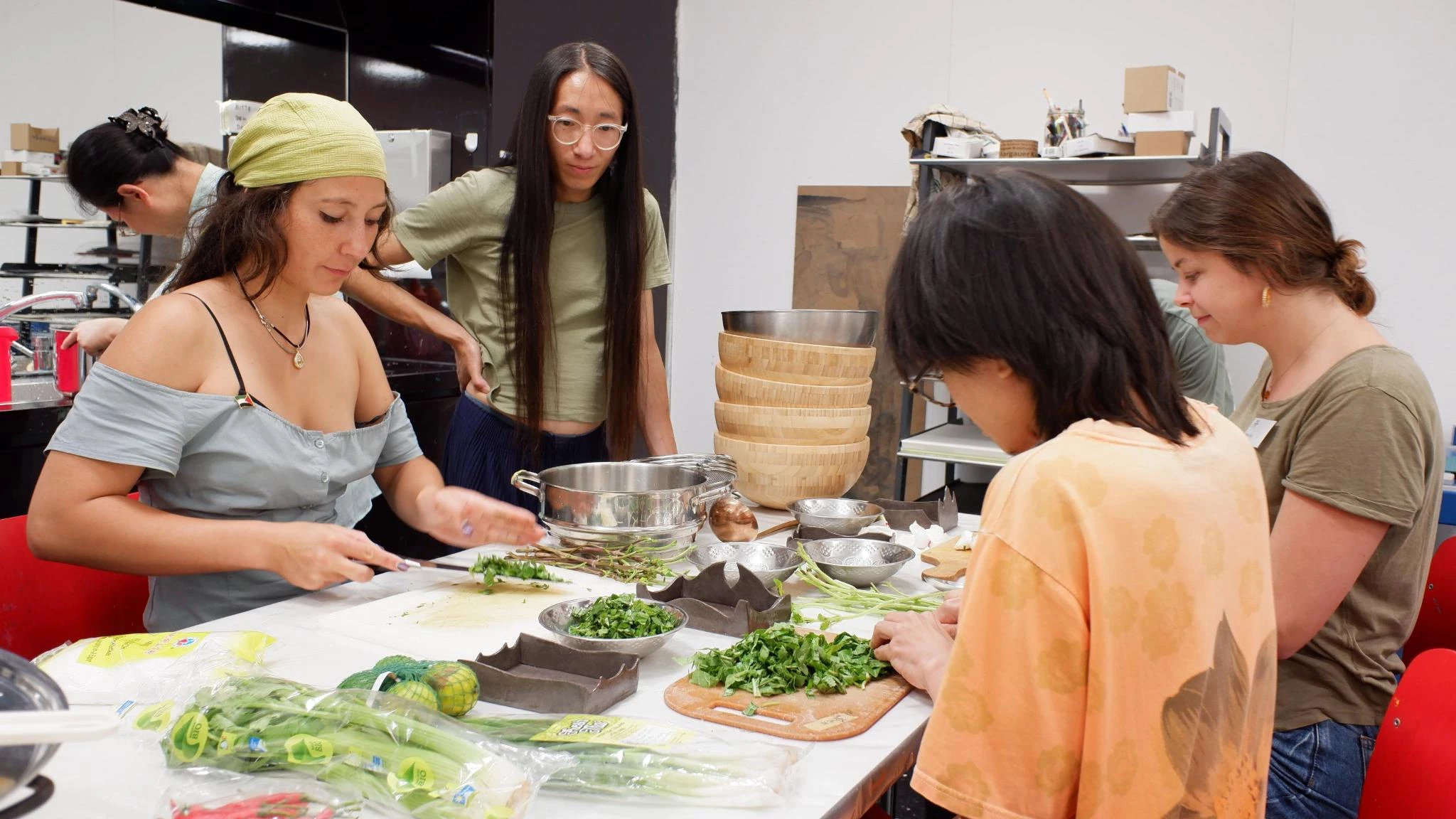
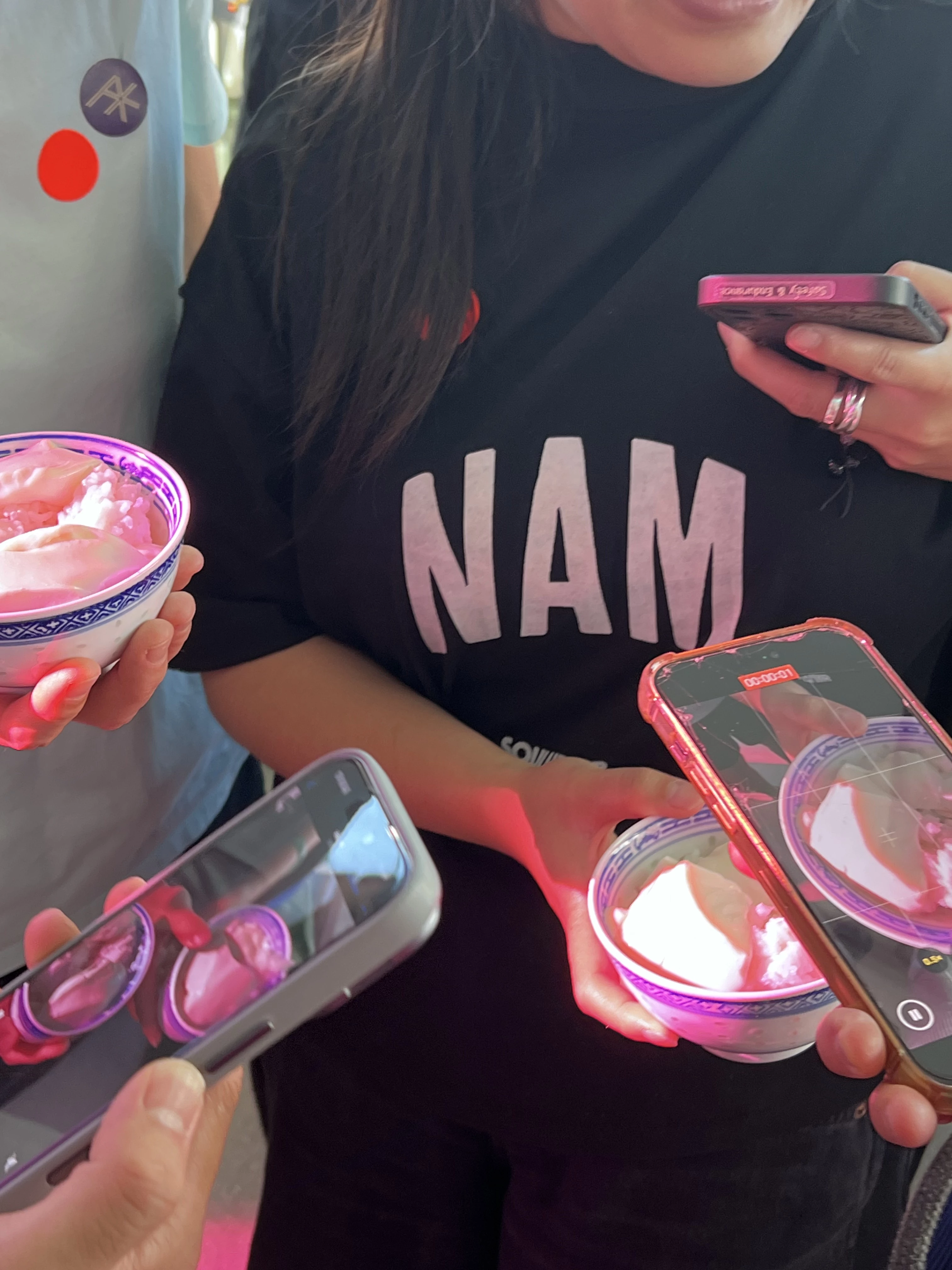
Tofutopia 豆腐托邦 is a video installation by HE Shen 何珅, which explores tofu’s contemporary identity as a racialised and queer agent, connected both to its Taoist alchemical heritage and to Caséo-Sojaïne, a Parisian tofu factory influential in spreading anarchist ideas to China. A series of tofu workshops acts as a performative counterpart to Tofutopia, positioning the collective act of tofu-making as a practice filled with subversive resilience, pleasure, and mutual care. This collective action reclaims the tofu-making space as a site of decolonial queer resistance.
Tofu’s versatile taste and malleable texture evoke a queer materiality that willingly accepts new characteristics imparted by sauces, spices, heat, force, and water. Inspired by this transformative nature, the workshop intentionally sets no fixed narrative beyond the communal process of making tofu. It evolves uniquely with each session, adapting to the spaces it occupies and the dynamic interactions of its collaborators and participants.
This recipe was born from a tofu workshop in summer 2025, as a collaborative encounter between Vanny, Daodao, and Shen. Our joint effort is rooted in intimate friendship and the growing momentum of an emerging Asian community in Switzerland. Simultaneously, the ongoing genocide in Gaza perpetrated by the Israeli settler-colonial regime—which has increasingly weaponised hunger—makes it especially urgent to revisit Caséo-Sojaïne’s vision of disseminating tofu-making skills as a means of nourishing communities suffering from malnutrition, hunger, and poverty.
Tofu’s revolutionary potential profoundly intersects with the Palestinian struggle and broader resistance movements opposing colonial violence in various communities and territories. The devastation in Gaza thus significantly informs Tofutopia, reinforcing its mission to foster decolonial solidarity across diverse communities and territories. Together, we will engage these interconnected threads, making tofu collectively, cultivating solidarity, and opening possibilities for creative work.
Soft Power: Making Tofu by Hand by HE Shen 何珅
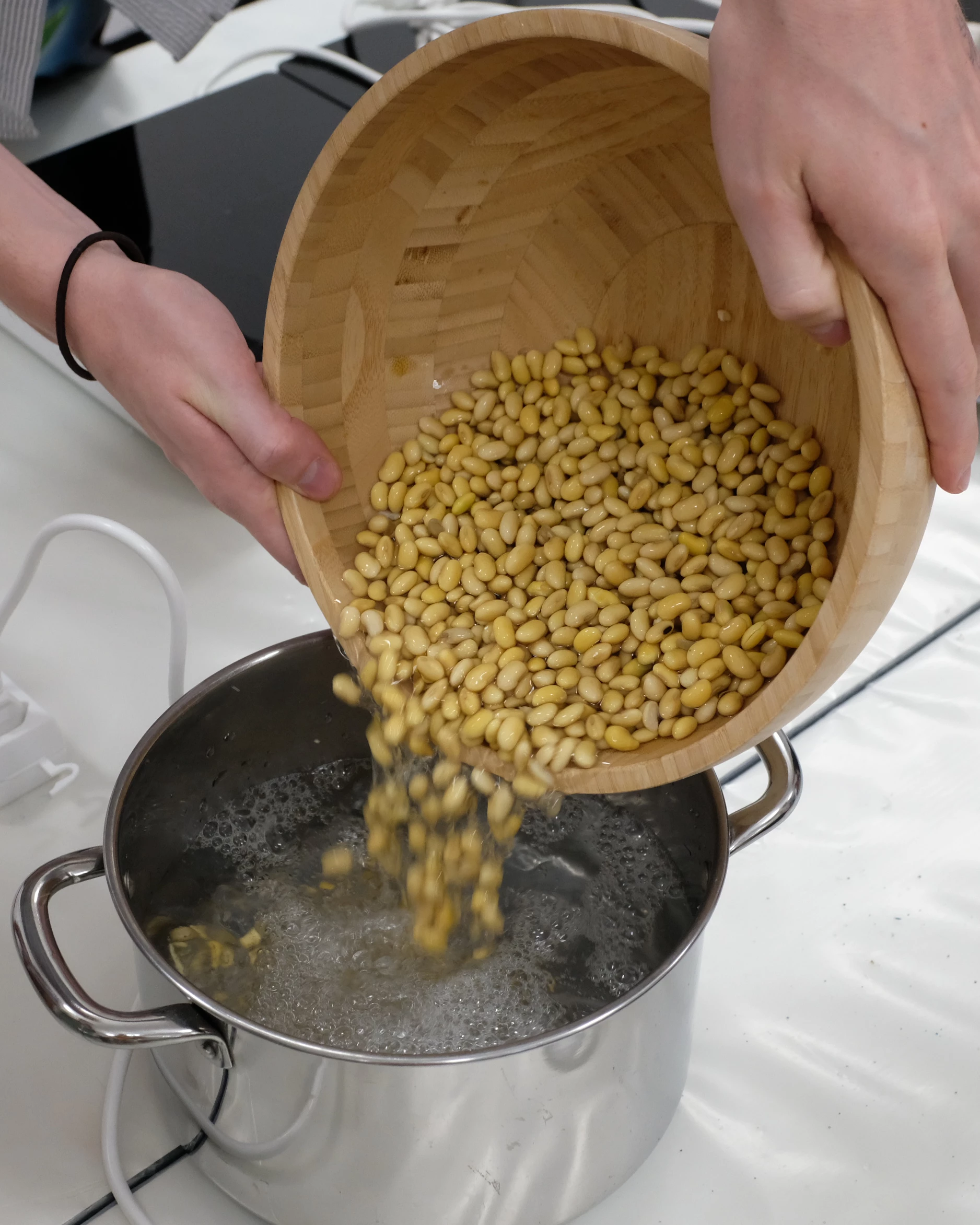
Soak the soy beans for 8 - 12 hours. Discard the water and pick out any impurities. In a large pot, combine the beans with fresh water. The ratio should be: dry beans to water 1:10.
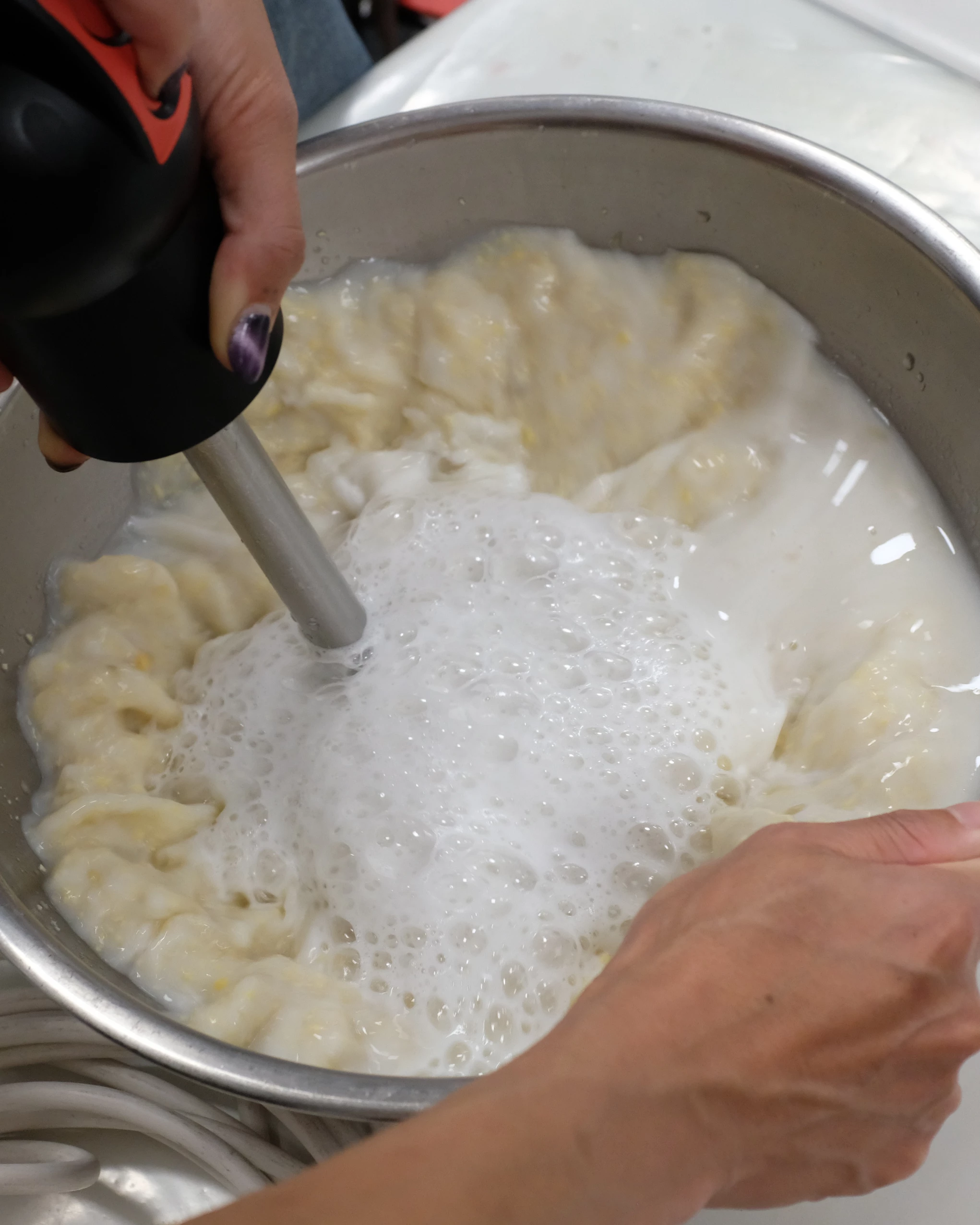
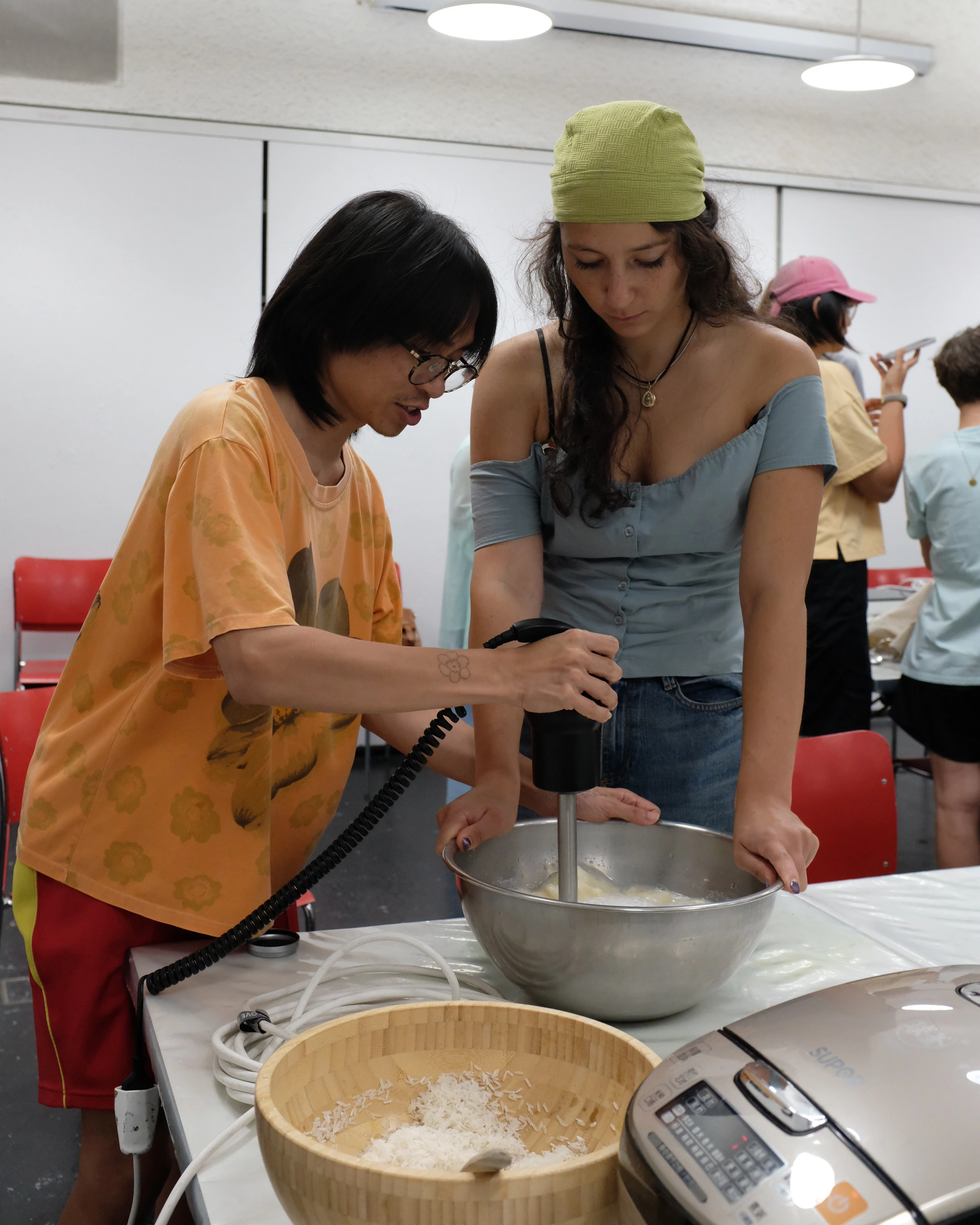
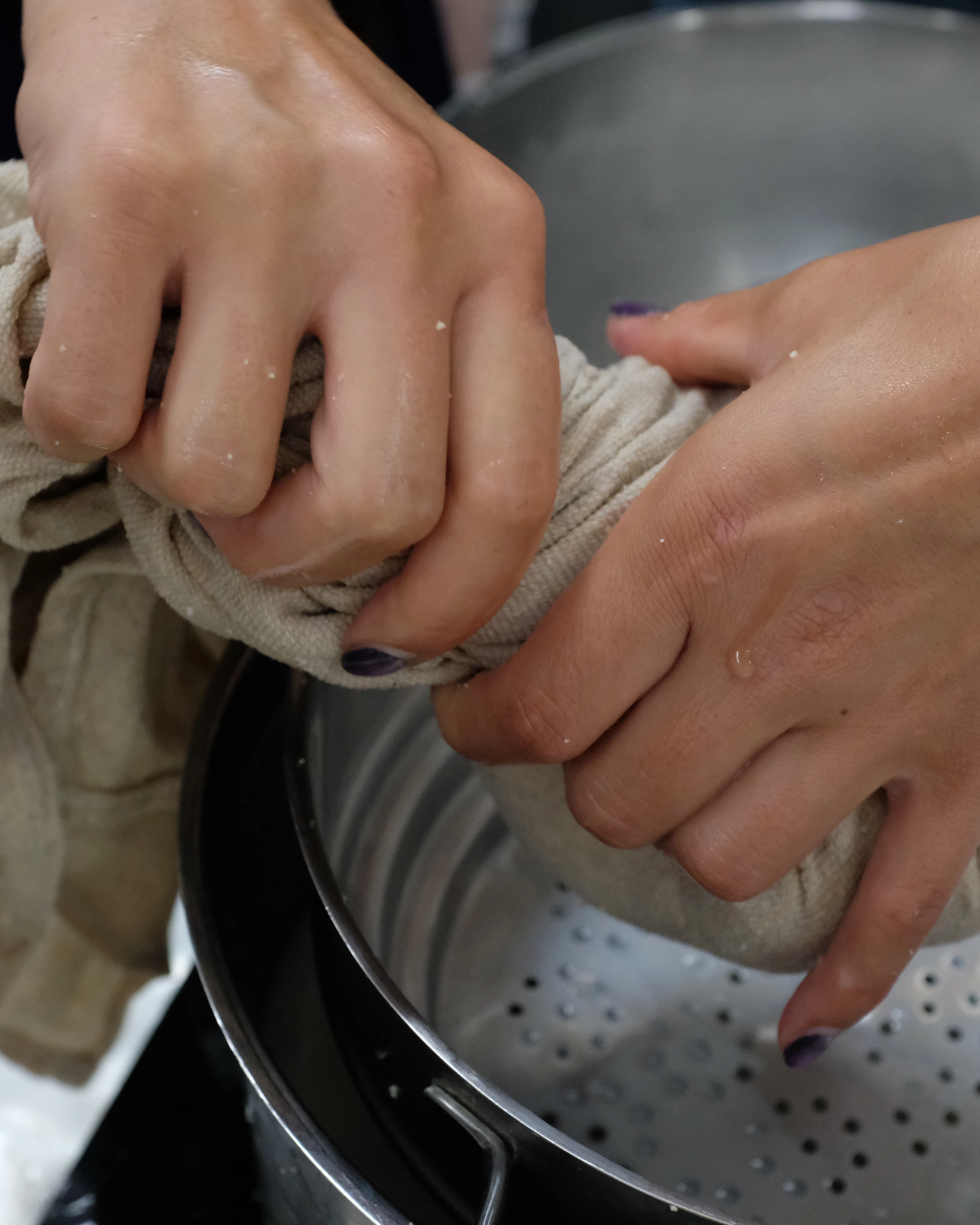
Grind the beans with a mixer or blender for at least 3 minutes. Discard any foam that may appear during blending. Apply the draining cloth on top of a colander. Filter the mixture, and make sure there are no particles in the filtered liquid.
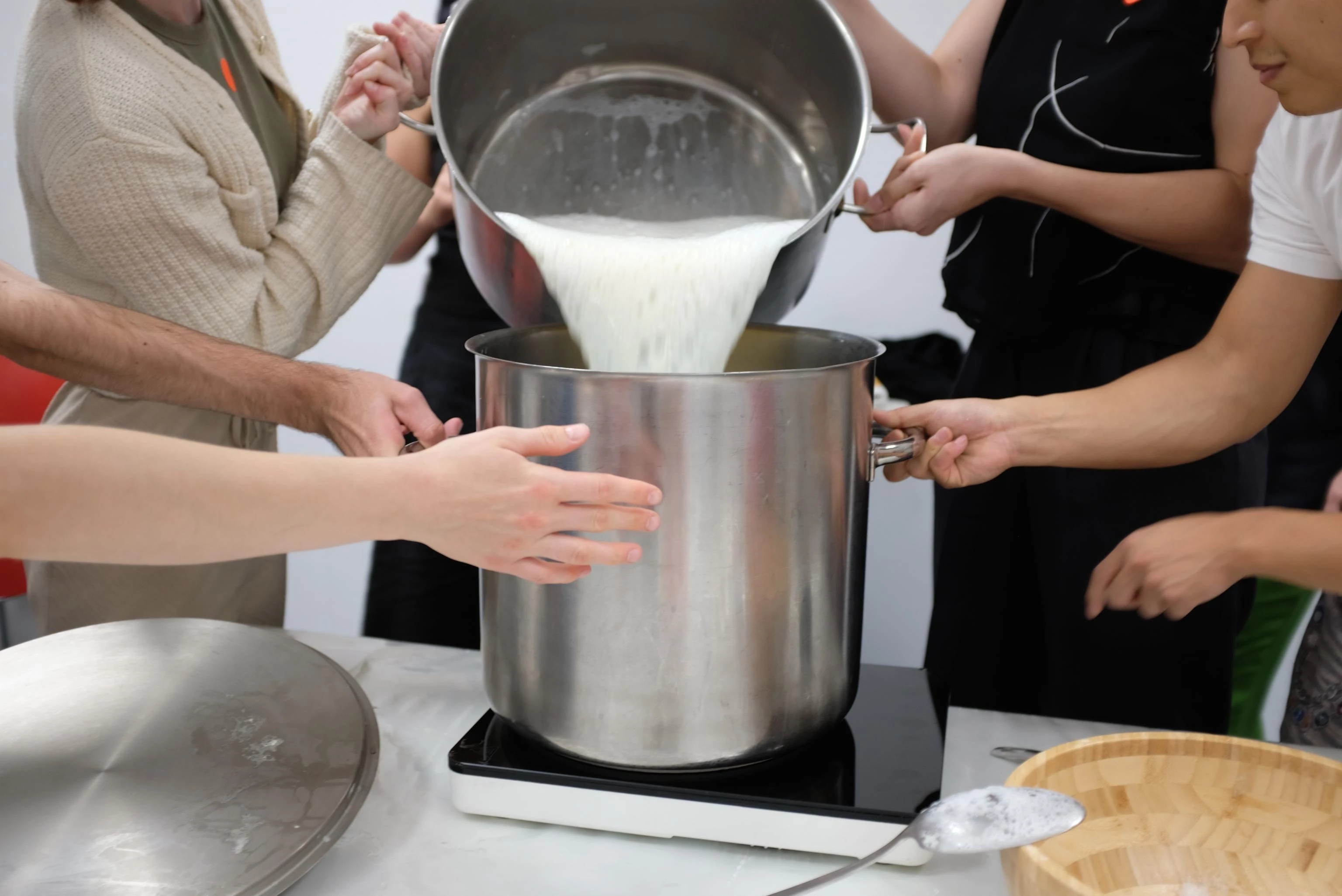
Heat the filtered blend. Keep stirring while heating up, and discard the excessive foam. Once the liquid is boiling, turn the heat down and keep cooking for 5 minutes. Turn off the heat and cool it briefly.
Prepare the electrolyte agent. Ratio reference for 100g dried beans: 10ml vinegar, 3g food grade gypsum, 2g food grade bittern, 2.5g gluconolactone (GDL).
Add the electrolyte agent. For silk tofu, a special skill is required: mix the electrolyte with 50ml of warm water and place it in a thermally insulated container.
Cool the soy milk to 85-90 °C, then pour it into the container with the electrolyte solution from 30 cm above. This allows the kinetic flow of the milk to mix well with the solution without stirring.
Keep the container closed and insulated for 25 minutes. If there is no insulated container, use a big pot instead, and put it on very low heat for this step. For silk tofu, the procedure ends here.
For pressed tofu, apply a piece of draining cloth to the formwork and then add the mixture. Wrap the mixture with the cloth and top it up with a flat lid. Apply weight to the lid and leave it for at least 1 hour. Overnight would be optimal.
The Stomach Tells the Truth (我是我所食) by Ni Daodao 倪島島
begins with an everyday object that is often overlooked: Chinese‑made bamboo or wood chopsticks, packaged with a clear “recommended use” period of three months.
These single‑use utensils come with a predetermined expiration — their death is sanctioned, normalized, and justified. This reveals a consumer logic around materials and time, as well as a disciplinary relationship between the body and nature in risk management.
I chose to apply Urushi — traditional Chinese lacquer that requires time, patience, technique, and precise humidity control — coating these chopsticks by hand, layer upon layer, over several months. This labor process is an act of companionship, care, and re‑animation.
Linked through heart and hand, the lacquer’s natural anti‑mold properties also reshape the relationship between microbes, objects, and the body, transforming these “expired” disposable items into kin‑like objects that receive care.
This artwork explores how food, the body, objects, and ecology interweave in contemporary life. To me, what I eat, how I eat, and the vessels I use to eat are all decisions about identity, environment, and ethics.
As The Material Kinship Reader suggests,
kinship is no longer confined to
human‑to‑human structures but becomes a coexistence among humans, materials,
microbes, and labor.”
Belonging, One Plate at a Time by Vanessa Bosch วาเนสซ่า
I don’t eat out or go for Thai food anywhere,
I was disappointed too many times before.
They never come close to my mom’s .
I know how she cooks, She fights with fire.
Her kitchen is a battlefield and a dance floor at once.
You better step out of her way when she shakes that wok.
Her face so grim,
so focused, I’ve always wondered
why she barely has any wrinkles, even at sixty.
Maybe it’s the steam.
She must cook from memory, but I know
it’s more than that. Her hands are guided
by something deeper, an instinct, a hunger
to create, to experiment, to stay alive in taste.
She bridges lives.
The one she was born into in Rayong,
and the one she carved out in Lindau.
I used to stare at the strange mix in her restaurant:
the heavy Bavarian wooden chairs, dark and carved,
planted between delicate Thai silk cushions and gold paper ornaments,
lacquered flower vases, sandstone elephants.
It didn’t make sense to me as a kid.
I wanted coherence, aesthetics.
She wanted home.
I observed spirit houses,
their gabled roofs and intricate carvings homes for energies, ancestors, the invisible.
And maybe that’s what she was doing, too.
Making a house for her spirits,
for her past and future to co-exist.
A place she could stand in fully.
South Germany didn’t give her that. Not at work,
not in the streets, not in the way people looked at her food like they owned it.
So she built her own resistance.
Decorated with dreams and remnants.
Refused to assimilate completely,
and refused to let go entirely.
Her belonging was something
she had to cook up herself, over years, like broth.
Strong, subtle, impossible to fake.
Now I see her still driven. Still tired.
Still trying to claim something for herself,
not borrowed, not translated,
not filtered through someone else’s taste.
She longs for more than survival, meaning,
a reason to be, not just a function.
Her cooking isn’t nostalgia, it’s a future
she keeps imagining with every dish.
A belonging
she insists into existence, one plate at a time.
Sauce for Tofu
Fry the tofu in oil until golden on all sides, then let it drain for a few minutes before slicing.
Finely chop garlic and fresh chili. Slice white onions.
In a pan, sauté the garlic, chilli, and onions until fragrant.
Gently add the tofu slices to the pan.
Add oyster sauce, soy sauce, a pinch of sugar, and a little pepper. Add a splash of water to create a light sauce that coats the tofu evenly.
Let everything simmer briefly until the tofu absorbs the flavours.
Flavour Companions for Two by HE Shen 何珅, Vanessa Bosch วาเนสซ่า and NI Daodao 倪岛岛
silk tofu 500g
pea starch or corn starch 3 tbs
chilli oil 3 tbs
soy sauce 3 tbs
oyster sauce 1 tbs
Thai chilli 1-3 pieces
Thai basil 1 bundle
celery 1 piece
spring onion 2 piece
garlic, minced or crushed 2 cloves
sichuan pepper, ground 1 tbs
lime 1 piece
pretzel sticks/other crisps 1 package
peanuts/ soybeans, deep fried 2 tbs
rice (optional) 2 bowls
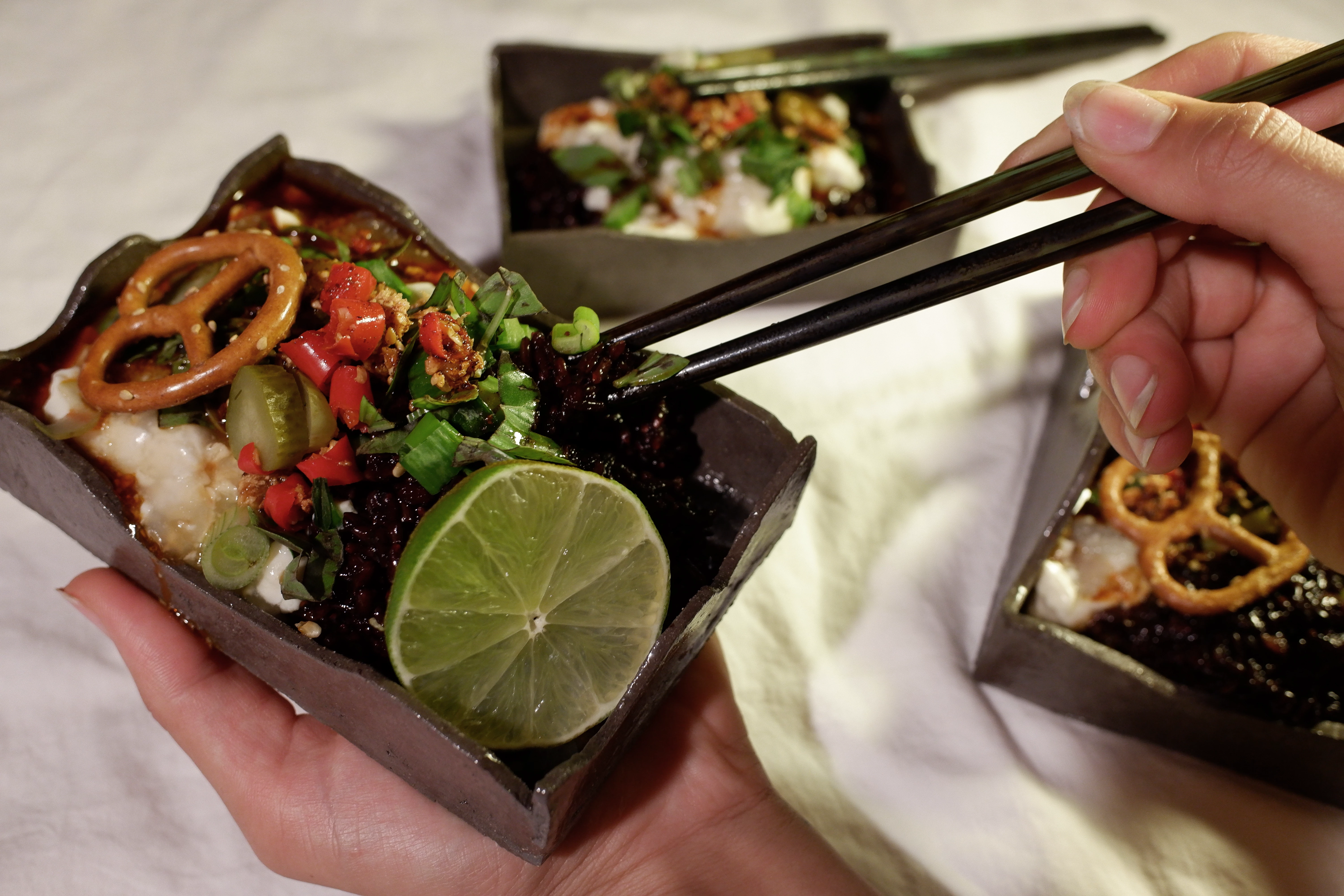
Mince all the herbs. Cut the lime into wedges. Crush or mince the garlic. Grind the sichuan pepper. Add the starch to a small pot and mix with 400ml of water. Cook the mixture on medium heat while stirring constantly. When it starts to boil, lower the heat and cook for another minute. Add the silk tofu to the mixture. Let the tofu warm up on residual heat.
Serve the tofu in a bowl, a tofu temple, or on top of a bowl of rice. Add the soy sauce, oyster sauce and the chili oil. Add all the herbs and spices. Add the pretzel sticks and peanuts. Add a splash of lime juice.

A Peanutbutter Chicken Recipe
of my uncle from Senegal
Inès Panizzi
- one-pot
- West African
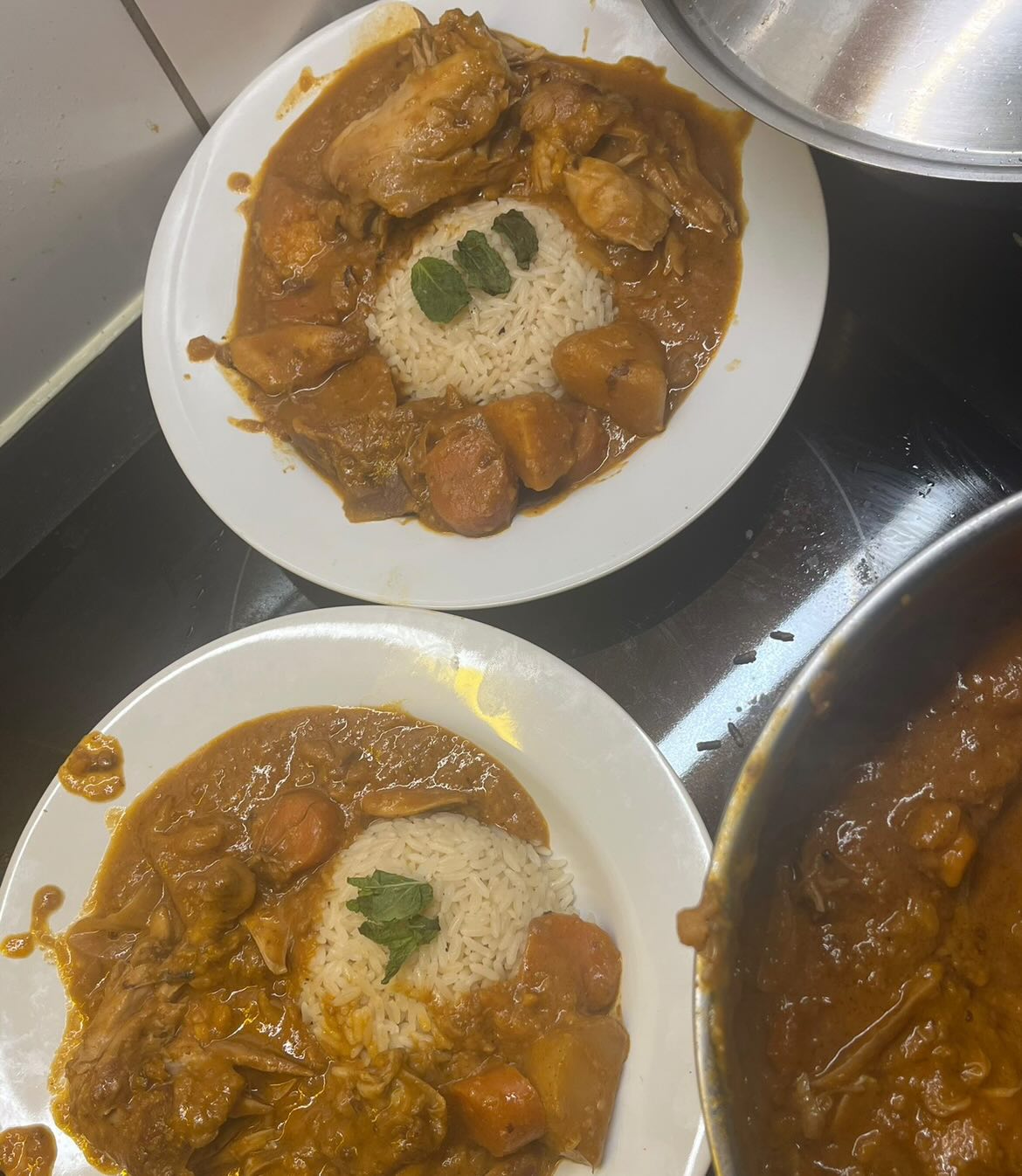
You need chicken, 1/2 white cabbage, 3 sweet potatoes, 4 carrots, 2 onions, tomato paste ~1 tablespoon and 1 can of peanut butter, garlic (2 cloves) and fresh ginger, and 2 bay leaves. Sauté the chicken and the onions (until brown) with the garlic and grated ginger, you add broth and you dilute the tomato paste, then you add the cabbage and carrots for 1/2 hour, then you add the sweet potatoes. You can add zucchini too. Towards the end of cooking, add the peanut butter that you have diluted in a bowl with the broth. There you go…
**Not very precise hehe but for a big pot and 4 big chicken legs i used one peanut butter jar
Veggie version: without chicken. Possible with white fish instead. Enjoy!
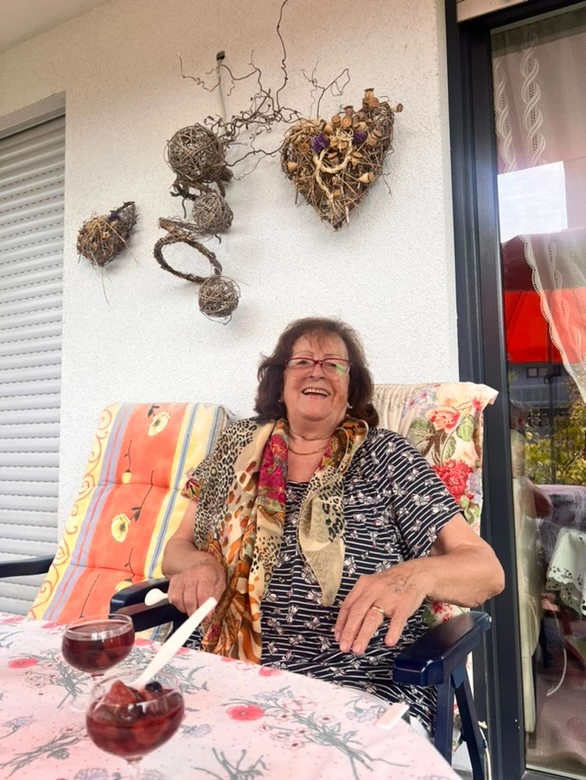
Granny Marianne’s Potato Salad
Janine
- side dish
- Germany
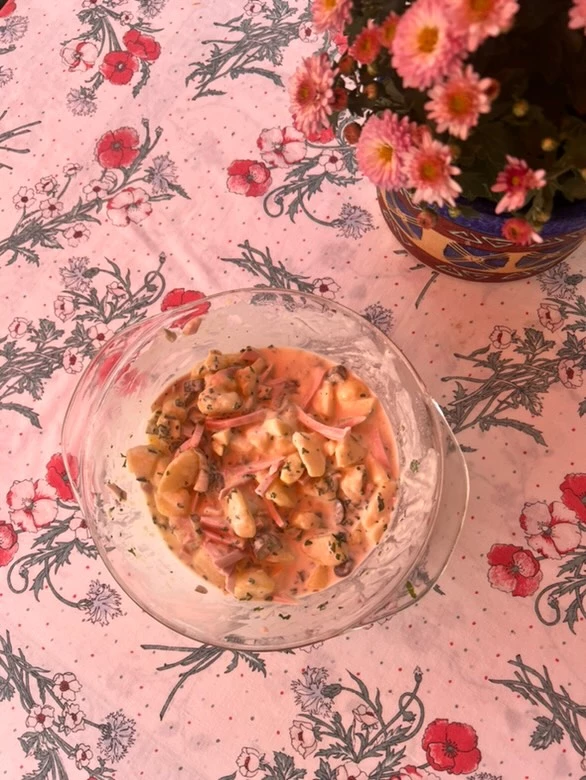
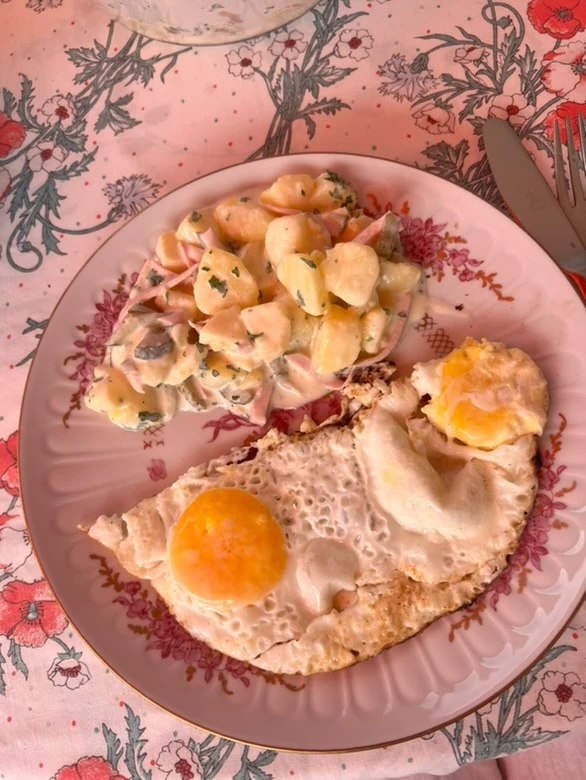
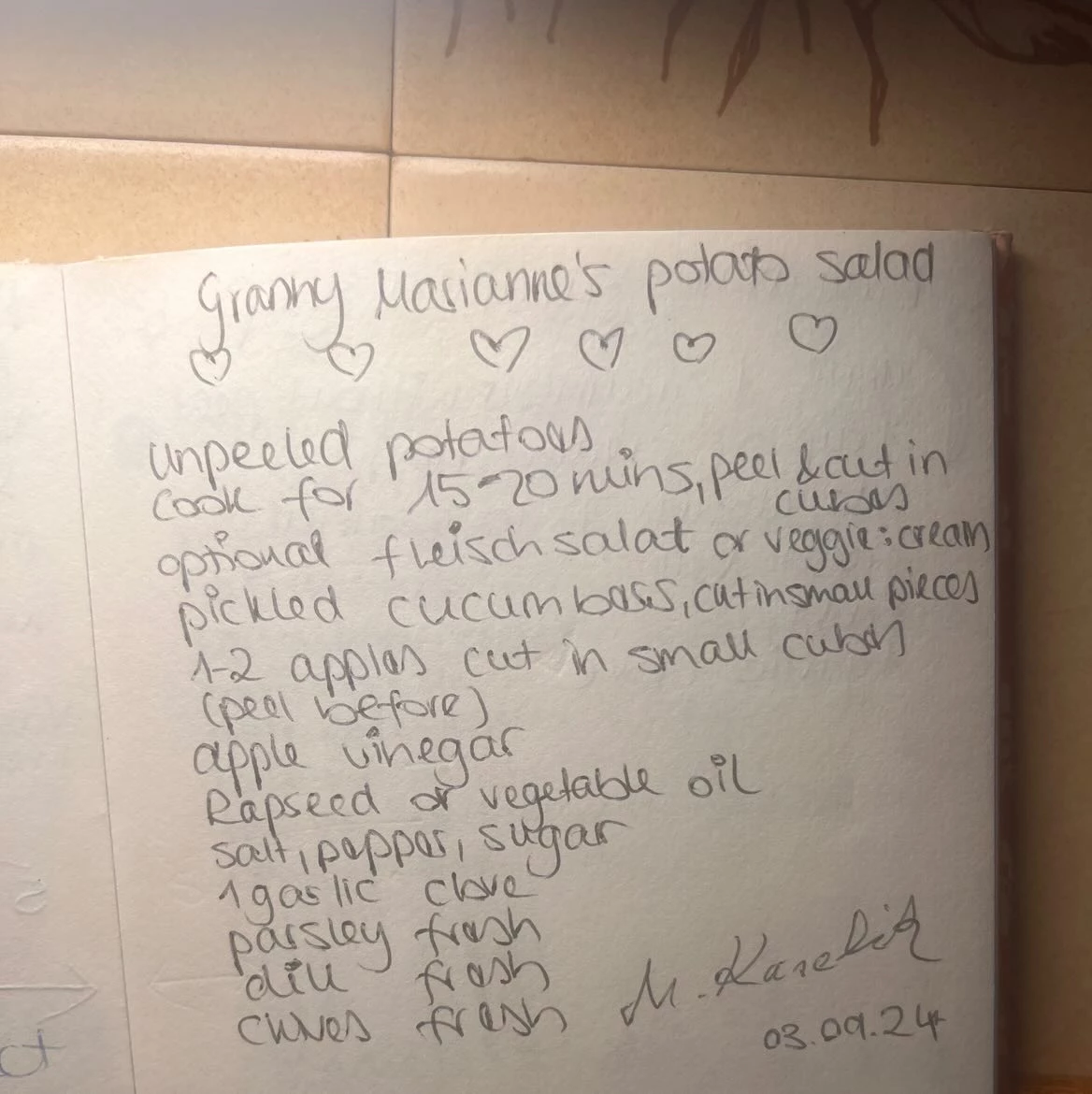
Unpeeled potatoes
Cook for 15-20 mins, peel and cut in cubes
Optional Fleischsalat or veggie cream
Pickled cucumbers, cut in small pieces
1-2 apples, peek and cut in small cubes
Apple vinegar
Rap seed or vegetable oil
Salt, pepper, sugar
1 garlic clove
Parsley fresh
Dill fresh
Chives fresh
As receitas da minha Avó Conceição
Joana Trindade Bento
- memory
- Portugal
A melhor receita que a minha avó me deixou foi a de aprender a fazer alguma coisa apenas por a observar. E, claro, a de fazer as coisas com alegria. E sempre acompanhada pela música da telefonia, quando não estava a falar com alguém que entrava pela cozinha adentro. Na casa dos meus avós sempre se entrou pela cozinha; sempre foi o sítio da casa onde passávamos mais tempo. E quando lá ia de visita, passava o dia na cozinha. Quando acordava, já havia três panelas ao lume ou uma carne pronta a ir ao forno. Há uns anos perguntei-me porque raio toda a gente tem receitas deixadas pelas avós e eu não. E fez-se luz: lembrei-me de que a minha avó Conceição era analfabeta; só sabia assinar com a primeira letra do nome.
Não me deixou receitas escritas mas lembro-me muito bem do paladar da sua canja, cheia de hortelã, feita com as galinhas que criava e que fazia questão de matar sempre que a íamos visitar a Idanha-a-Nova, para nos receber com a sua canja com ovinhos. Lembro-me também do estufado de borrego, do arroz-doce, do caldo verde e dos pastéis de massa tenra.
O que me ensinou foi a saber combinar sabores mais do que a medir quantidades. Ensinou-me a fazer mesmo as coisas, a pôr a mão na massa e a não ter medo de errar; a observar, a ir à horta buscar as coisas, a receber os outros e a ter prazer em cozinhar.
Como estava sempre a pregar partidas, ensinou-me que a hortelã era urtiga, só para se rir quando eu me picava ao apanhar a planta errada.
Quando lhe tiraram a cozinha, deixou de falar e eu deixei de a ver. Quando morreu, em 2020, estas receitas e memórias voltaram a habitar em mim. Lembro-me de tudo.
The best recipe my grandmother left me was to learn how to do something just by watching her. And, of course, to do things with joy. And always accompanied by music from the telephone, when she wasn't talking to someone who came into the kitchen. At my grandparents' house, we always entered through the kitchen; it was always the place in the house where we spent the most time. And when I went to visit, I spent the day in the kitchen. When I woke up, there were already three pots on the stove or meat ready to go in the oven. A few years ago, I wondered why everyone else had recipes left by their grandmothers and I didn't. And then it dawned on me: I remembered that my grandmother Conceição was illiterate; she could only sign her name with the first letter of her first name.
She didn't leave me any written recipes, but I remember very well the taste of her chicken soup, full of mint, made with the chickens she raised and which she insisted on slaughtering whenever we visited her in Idanha-a-Nova, to welcome us with her chicken soup with eggs. I also remember the lamb stew, the rice pudding, the green soup, and the tender dough pastries.
What he taught me was how to combine flavours rather than measure quantities. She taught me to really do things, to get my hands dirty and not be afraid of making mistakes; to observe, to go to the garden to pick things, to welcome others and to enjoy cooking.
As she was always playing pranks, she taught me that mint was nettle, just to laugh when I got stung picking the wrong plant.
When they took her kitchen away, she stopped talking and I stopped seeing her. When she died in 2020, these recipes and memories came back to me. I remember everything.
Sonhos
Laura Monteiro
- sweet
- xmas
- Portugal
pedi à minha mãe para tirar uma fotografia a esta receita do caderno da sua mãe
Minha querida avó e amiga que trago sempre comigo. chuva de quem não vai e de que não haverá quem
conhecer
igual igual igual
O coração das nossas casas será sempre as suas cozinhas. Famílias e suas cozinhas.
Minha avo era uma pessoa de pessoas à mesa, de gente a beber, gente a comer, gente a falar e a chegar.
Não era famosa pelo sabor ou delicadeza da sua cozinha, era meio bruta,
sempre as grande quantidades absurdas
para ficarmos todas bem e para quem mais pudesse chegar
Mas sempre foi assim, e assim sempre foi transmitindo, aparentemente sem saber, a ritualidade que existe em fazer e partilhar uma refeição.
era canhota mas obrigaram-na a não ser
Sabia fazer muitas coisas com ambas as mãos
e tinha letra de matemática que vou tentar decifrar:
(aproximando-me)
Esta receita é feita no final do ano.
Receita de sonhos.
7,5 dl leite, 15og margarina, 450g farinha, 12 ovos, 1 casca de limão, 1 pitada de sal.
Pôr ao lume o leite, a manteiga, sal e casca de limão. Quando ferver deitar a farinha de uma só vez e deixar cozer até fazer uma bola e descolar-se do fundo da panela . Tirar do lume, retirar o limão e deixar arrefecer. Amassar um pouco com a mão. Acrescentar 1 ovo, bater bem (5 a 10 minutos). Ir acrescentando os ovos, 1 de cada vez, batendo sempre. Numa panela funda Colocar óleo (2 dedos de altura). Quando estiver bem quente pôr em lume mais fraco e ir deitando colher (sobremesa) de massa. Lume brando para crescerem sem queimar. Ir virando os sonhos (furando com um garfo ou com uma agulha de tricot). Polvilhar com açúcar e canela e/ou regar com calda de açúcar.
Não sou uma das pessoas que gostam sonhos. Ou talvez sim, adoro.
O que eu mais aprecio nos sonhos são as suas ideias, conexões mentais e emocionais.
Fazer sonhos.
Bater sonhos,
15 ovos, cada um de uma vez, por 9 minutos.
9 minutos em circulo e espiral.
Trocar de mãos, as duas, só uma e passar a outras, de alguém.
Fritar os sonhos em óleo bem quente.
Feito com técnica torna-os arredondados e eles vão-se virando de barrigas para cima, como que a rebolarem em sonos e acordares.
Feitos com menos técnica mas como uma intenção ao aleatório, ao divinatório, podem ser feitas, em final de ano, previsões para um próximo.
I asked my mother to take a photo of this recipe in her mother's notebook.
My dear grandmother and friend who I always carry
with me. In tears of those who will never be
and who will never know me
the same the same.
The heart of our homes will always be
their kitchens.
Families and their kitchens
My grandmother was a person of people at the table,
people drinking, people eating, people talking and
arriving.
She wasn't famous for the taste or delicacy of her
cooking, she cooked in a rough way, always in absurd
quantities so that we would all be well and for
whoever else might arrive.
But that's always led by, and teaching others, maybe
without noticing, the ritual that exists in making
and sharing a meal.
My grandmother was left-handed, but she was forced
not to be. She knew how to do many things with both
hands.
She had mathematical handwriting that I'm going to
try to decipher:
(coming closer)
This recipe is made at the end of the year.
Recipe for dreams (sonhos).
Dreams are made from milk, flour, butter, eggs, lemon
zest and a pinch of salt.
Put the milk, butter, salt and lemon zest. When it
boils, add the flour all at once and cook until it
turns a ball and detaches from the bottom of the pan.
Remove from the heat, remove the lemon and leave to
cool. Knead a little by hand.
Add 1 egg and beat well (5 to 10 minutes). Add the
eggs, one at a time, beating constantly.
In a large pan pour in oil (2 fingers high). When it's
very hot, put it on a low heat and add a dessert
spoonful of dough. Keep on a low heat so they rise
without burning. Turn the dreams over (piercing with
a fork or knitting needle).
Sprinkle with sugar and cinnamon and/or drizzle with
sugar syrup.
I'm not one of those people who love dreams. Or yes,
I love.
But what i like most about dreams are ideas that are
transmitted, brainy and emotionally connections
Making dreams. Beating dreams, 15 eggs, each one at a
time, for 9 minutes. 9 minutes in a circular and
spiral mood. Change hands, both of them, just one,
and pass them on to someone else.
Fry the dreams in very hot oil. Done with technique,
it makes them round and they turn belly-up, as if
rolling over in their sleep and waking up.
Done with less technique but with the intention of
being random, divinatory, you can make predictions
for the next year.
Kitchen Archive Routine from August 15, 2025
Leen ElMobaddr
- leftover
- memories
- Lebanon
- Portugal
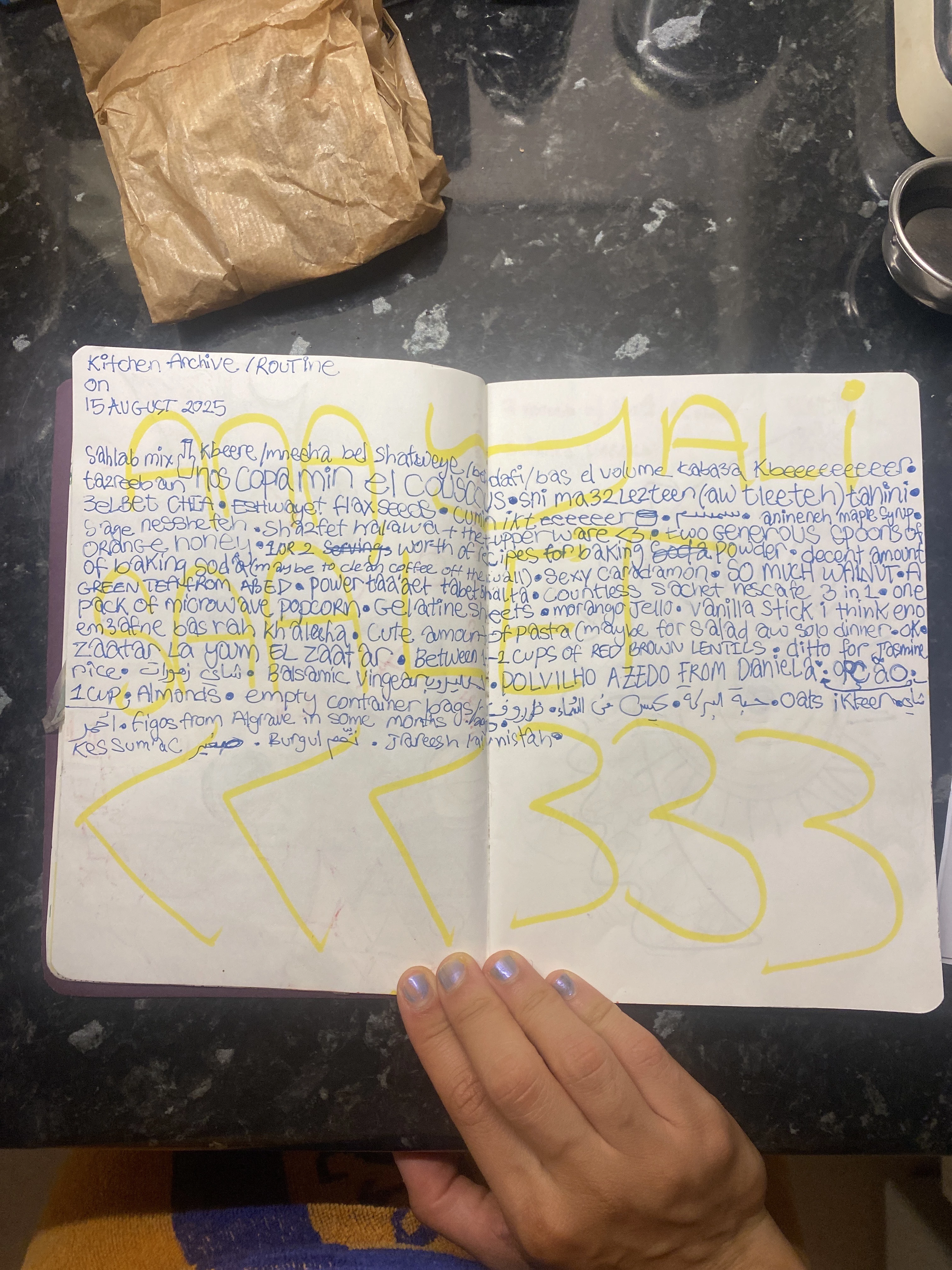
Sahlab mix (a milk pudding drink commonly drunk in Lebanon, Palestine. must have with cinnamon lots, good for winter, keeps you warm, however the quantity is aloooooooot) - approximately 1/2 cup of couscous - around 2 (maybe 3) tablespoons of tahini - a box of chia - a little bit of flaxseeds powder - aloooooot of cumin - sim-sim (sesame in arabic) - maple syrup bottle - dried sage - a piece of halawa (tahini fudge) + the tupperware <3, from lebanon - two generous spoons of orange honey from ALGARVE - baking powder worthy for 1 or 2 recipes - decent amount of baking soda (can be used to clean coffee from the wall before moving out) - sexy cardamom powder from Alishka - SO MUCH WALNUT - GREEN TEA FROM ABED - countless sachets of nescafe (3 in 1 & 2 in 1), this is a strangely/particularly a lebanese thing - one pack of microwave popcorn - gelatine sheets (from these, came the idea of making berry jelly tarts! that i sell now) - morango jello - vanilla stick that i believe has rotten (sounds better in arabic: m3afneh) but i will keep it - cute amount of pasta (maybe for a salad or a solo dinner) - ok - zaatar la youm el zaatar (zaatar until zaatar day), this is an common way of structuring a sentence for an expression that alludes to the plentifullness of something, endless, countless. can be for a feeling, emotion, or material. - between 1 or 2 cups of red brown lentils - ditto for jasmine rice - ZOUHARAT TEA (herbal rose tea from lebanon) - balsamic vinegar syrup - POLVILHO AZEDO FROM DANIELA - aLMONDS - empty container bags - a bag that has sumac - nigella seeds/ habbet al barakeh (in arabic it translates to blessing seeds) - alots of oats - red tea (we don't say black tea in arabic,) - dried figs from Algarve - Burgul (mostly used to make kebbeh and tabbouleh) - jareesh grain (i got it to make mashateeh, a type of bread very familiar from my auntie) - hazelnut coffee mix from Rifai roastery (which I decided to use as an ingredient base for a delicious desert concept i called SHAPES OF POWER -
It is, quite simply, a list of all the ingredients currently in my pantry, written as a kind of recipe for memory. The act of archiving these ingredients is both practical and symbolic: on the one hand, it helps me consciously create recipes that allow me to finish what I have before moving; on the other, it serves as a reflection on how we live with, accumulate, and sometimes forget the things that nourish us. Doing this also revealed a very intimate process.
For me, this kitchen archive becomes a recipe of the everyday. It speaks to the routines through which I cook and feed myself, and it transforms the pantry into an intimate map of presence, absence, and care. Sharing the full list of ingredients feels like opening up a very personal space—one that can be as revealing and tender as sharing a traditional dish.
digital archiving this list today, i still have elements from it that i have passed to my new home. As winter comes, I feel excited to explore the sahlab mix and what else I can do with it. This process revealed to me how much more fruitful it is to cook with leftover ingredients, and how important it is to maintain a constant archive of my kitchen supplies and ingredients. Saying this now, maybe as we transition to autumn, it can be nice to see what my archive looks like today.
Cooking an ethnography?
Some thoughts on food, research, and memory
Maria Isabel Lemos
- couscous
- Cabo Verde
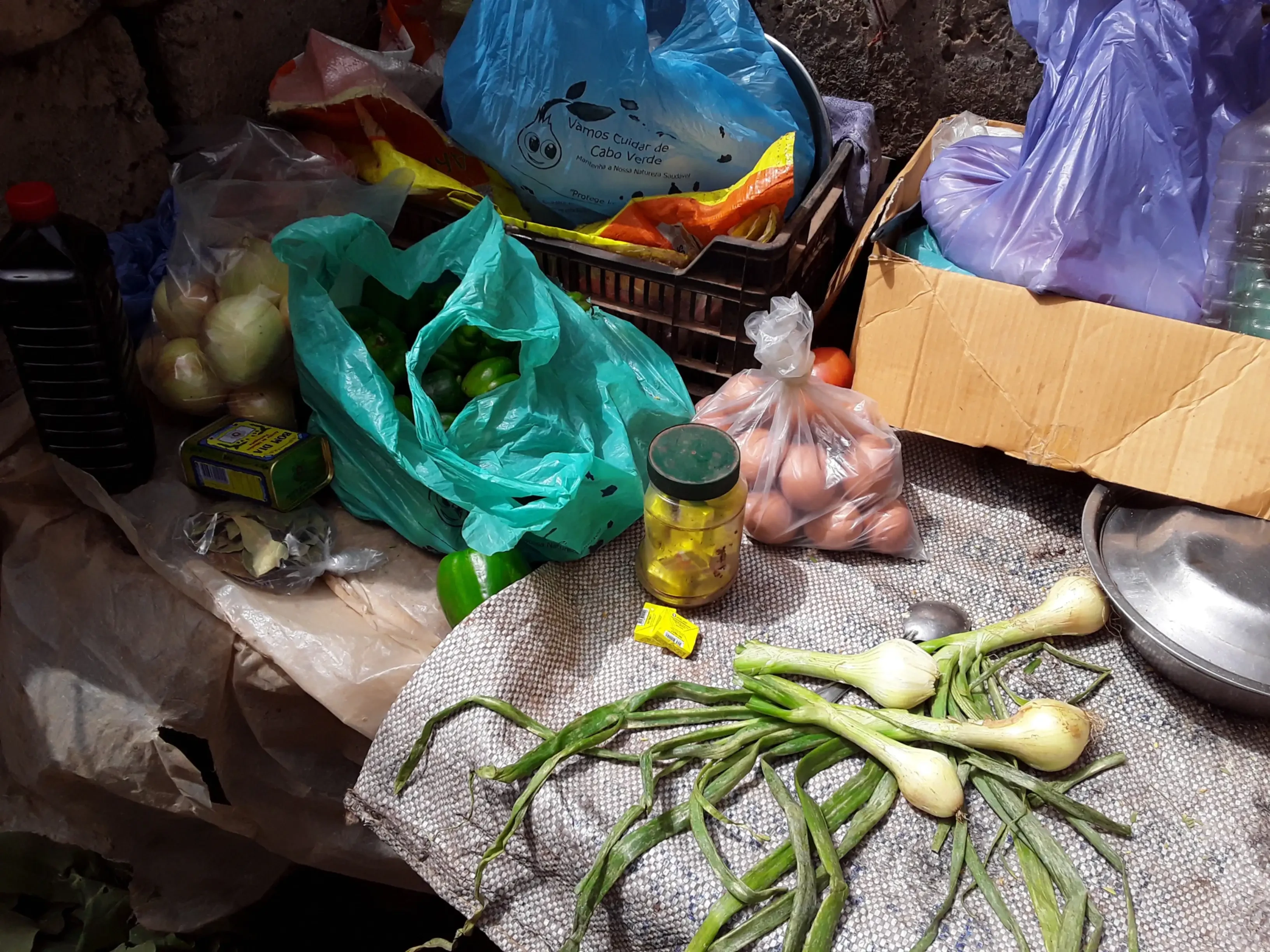
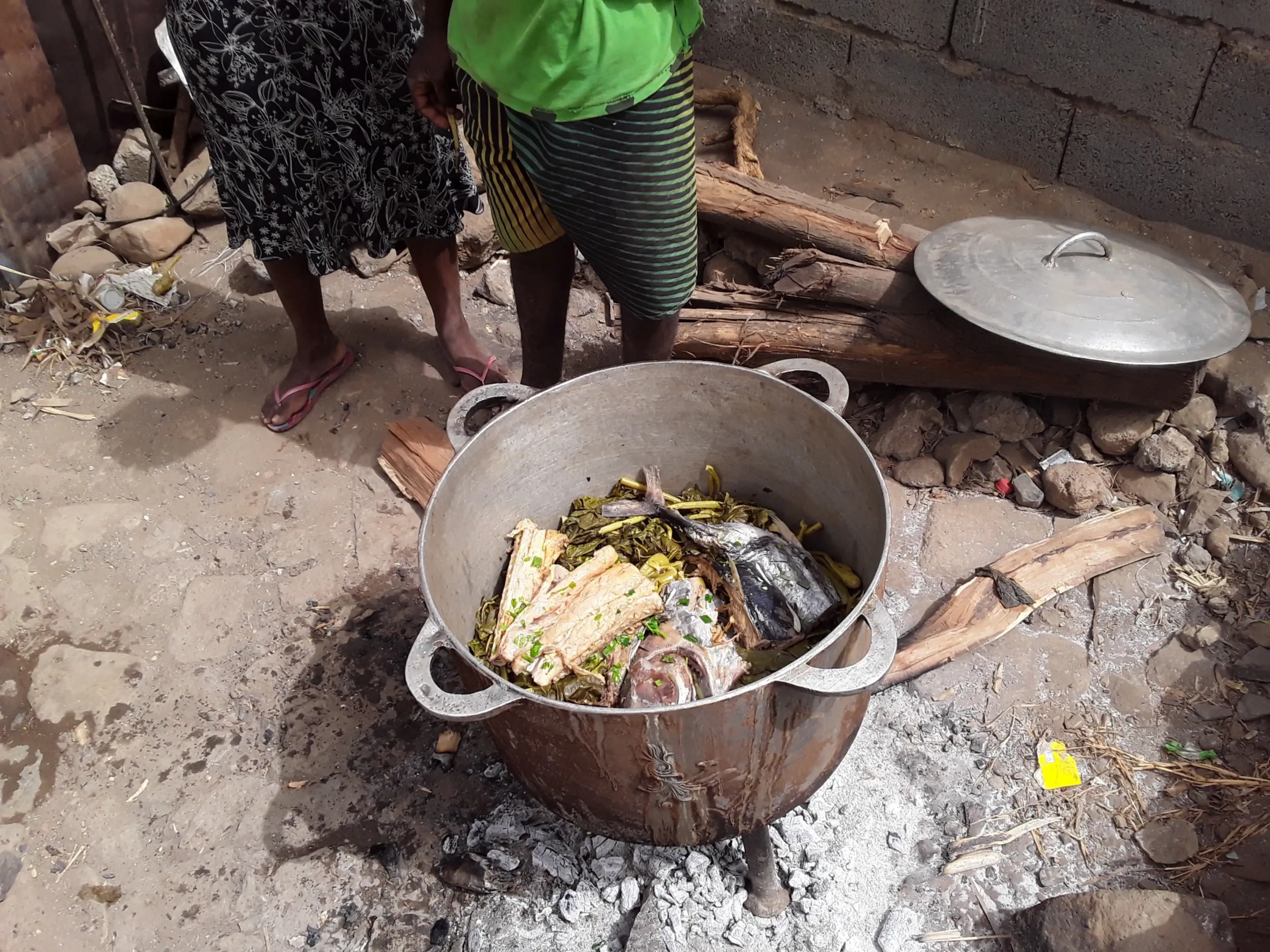
Cooking and food are ordinary daily topics that might be understood as side subjects, as they were back in my home, in Brazil. When it comes to culture, memory, and research, these two become gateways to intimacy, sensibility, ritualistic practices, and politics. Food was one of the main channels through which I managed to bond with Cape Verdeans in the countryside area of Santiago Island. Located in the Central Atlantic, Cape Verde was exploited by the Portuguese up until 1975. The archipelagic history is ravaged by its arid climate, droughts, and the colonial poor management of the consequent famines. Food is political. And it is an important topic for the people, who’s attachment to their cuisine surpasses geographical boundaries, entering the memory realm in all corners of the vast Cape Verdean diaspora.
During my last fieldwork, I was researching Cape Verdean traditional tales and finding storytellers in the rural areas was a difficult task: my references were either dead or had already forgotten the stories. Up until I met Abel. But this is not about him - or his tales - it is about his family and how, at first, food became a bridge between my experiences and theirs. My weekly visits to their household had started a few months before the catholic celebration that marks Lent’s beginning and, since then, the sole topic the three women residing in the house discussed with me was food. The lack of it, the taste of it, the proper way to prepare it. They were curious about how we made couscous in Brazil or with which ingredients we cooked feijoada. The kitchen was full of their secrets, their opinions on life, marriage, and their role as women. And it was the only space in which they recognized me as a woman too, for in the living room I quickly became the foreign researcher again. This came as no surprise: gender inequality is one the archipelago’s major problems and it took me sometime to get past the feminist questioning and look at these conversations as steps towards intimacy and sharing experiences.
1 Morgadio refers to a system of hereditary succession in which property is passed down to a single heir, forming an indivisible and inalienable estate.The term morgado designates the person who inherits and holds the morgadio.
2 A special steaming pot used to make couscous.
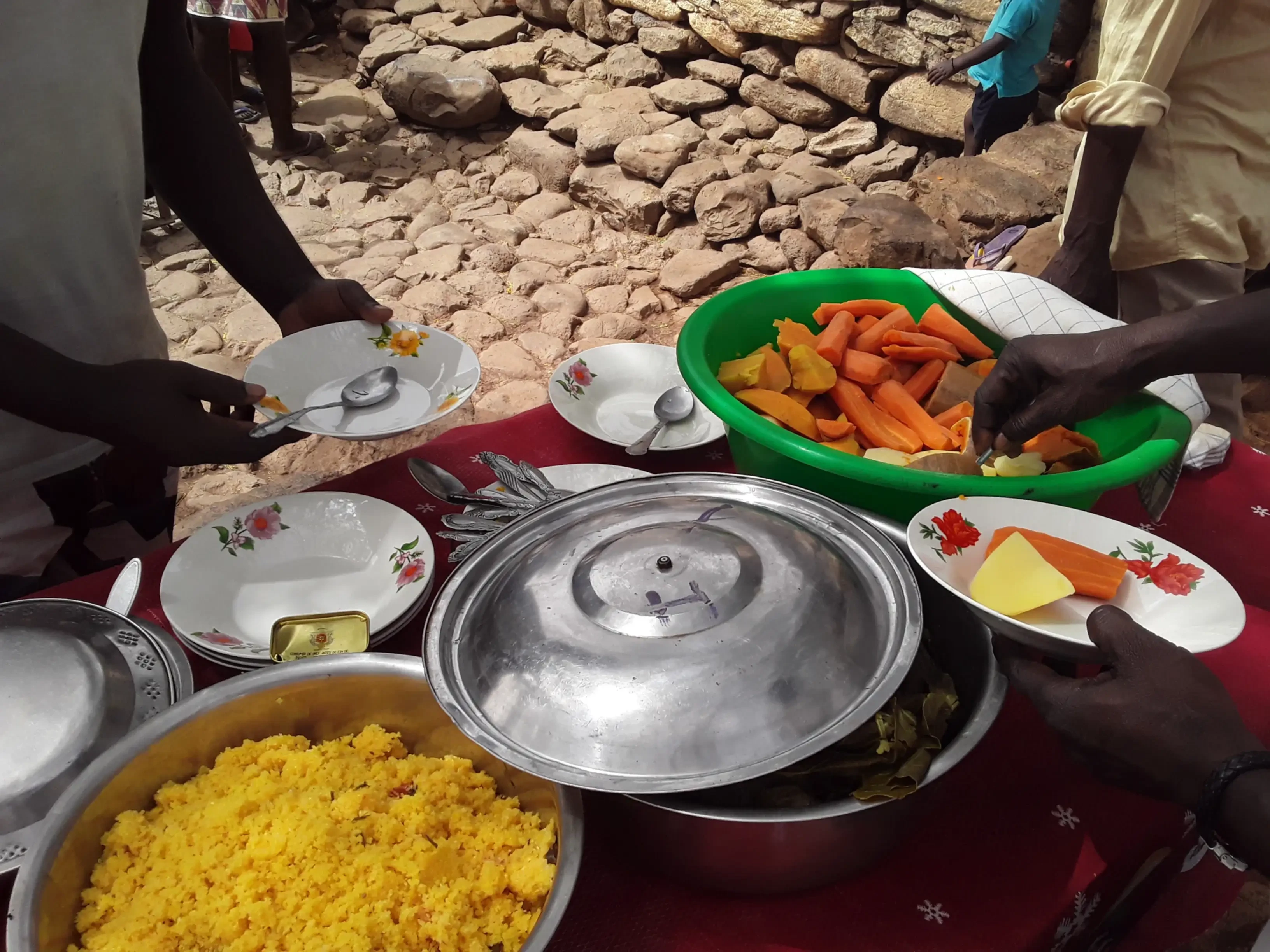
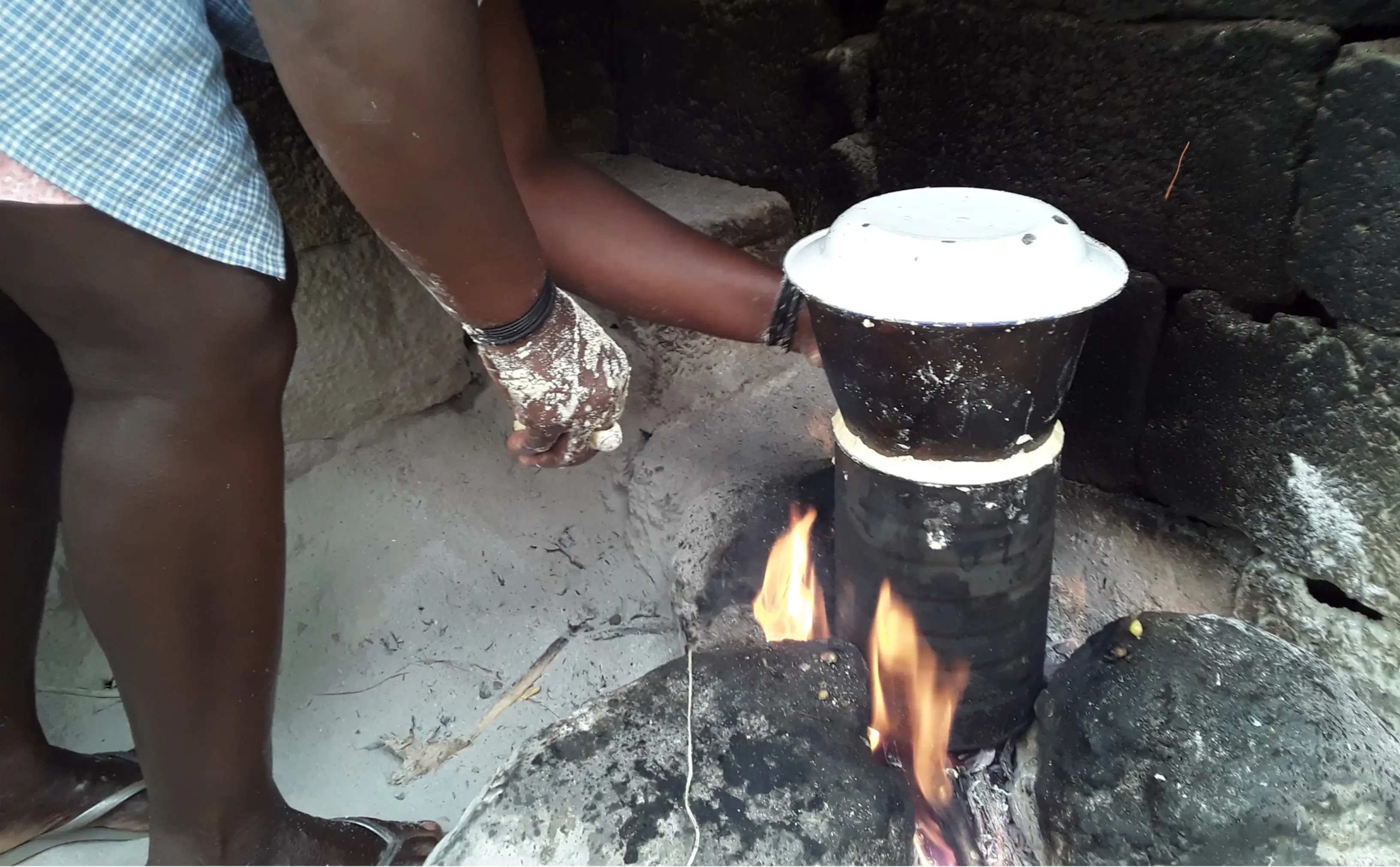
We started cooking together whenever I visited their home and after a few shared bowls of xerém, they invited me to join their family celebration of Festa das Cinzas. The catholic liturgy indicates fasting as a rule, but in Santiago Island, the first to be occupied and colonized, Ash Wednesday became a day in which enslaved people got to eat more since the morgados1 were fasting. There is a great deal of catholic influence in Cape Verdean cultural and institutional practices, but the contours of certain rituals tell the many different versions of a single story. In Ribeira Seca, the celebration starts at home, with the family, and after that, some people visit their neighbors, at least, it was what we did. My duty was to bring fish from the Sucupira market and help them cook xerém, cabbage, cassava, potatoes, coconut, couscous with honey, and dried fish to the relatives who were joining. The celebration actually starts way earlier than lunch, in the market, where the ingredients are bought. The second act happens in the kitchen, when the food is prepared. I remember the women moving around quickly, and me being dreadful about taking the couscous out of the binde.2 I was cautious and aware and at first I thought it was because of my role as a researcher, but coming to think of it, it was because of the intimacy of such a situation in which I had never taken part.
That experience was not new to me as a researcher, but it was completely new for me as a person. Ash Wednesday symbolism synthesizes our mortality, the finitude of the individual experience. But on that lunch, finitude was not the topic: the continuous adaptation of traditions and practices allows for the never ending creation of narratives, pasts and recipes. And community practices impact and shape individual memories, for they are ties of the same complex fabric of social experience. Memory draws from multiple senses and this photographic essay is an attempt to understand what changed for me that day, in that kitchen, now that the smell of the feast seems so distant.
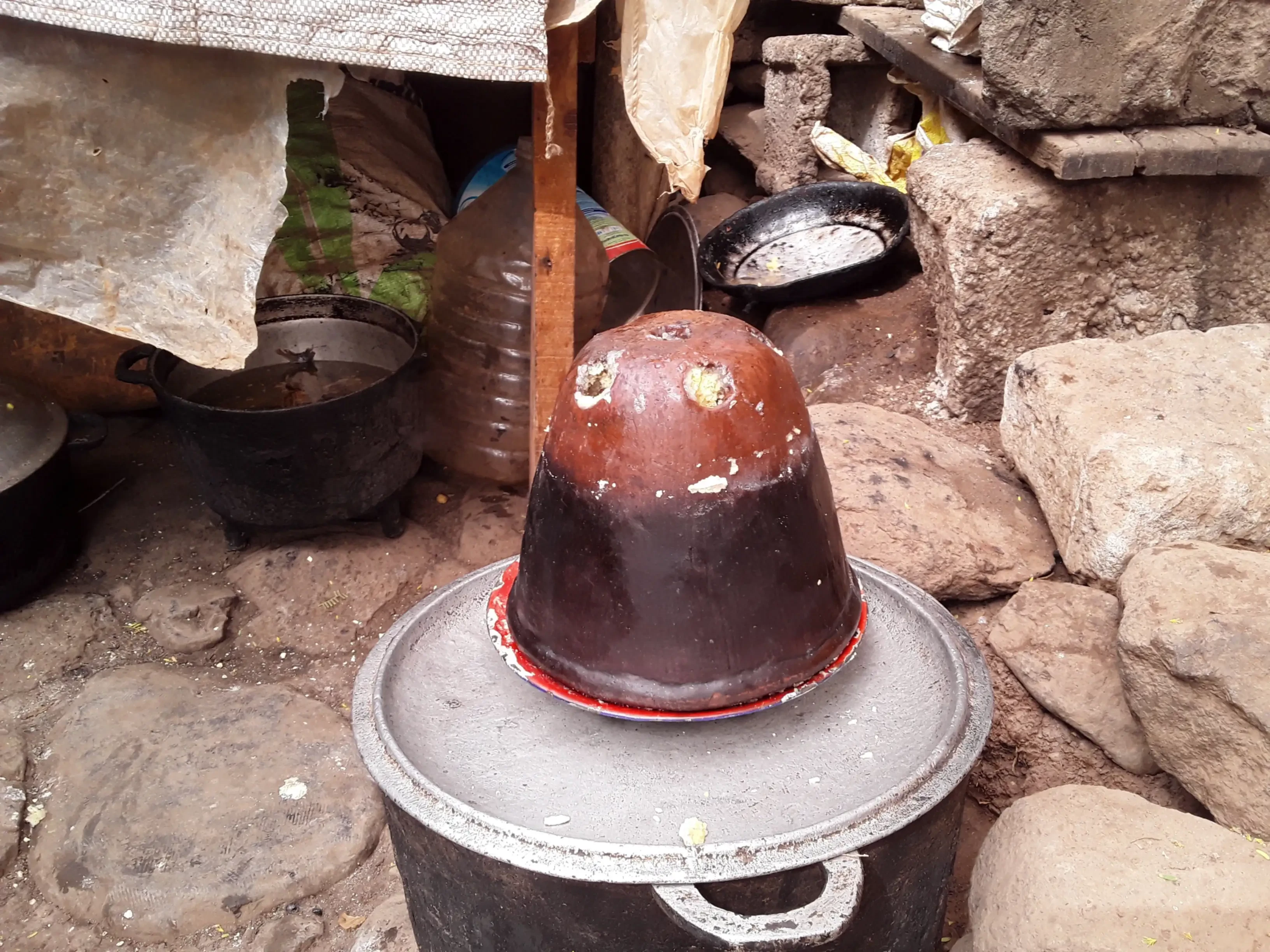
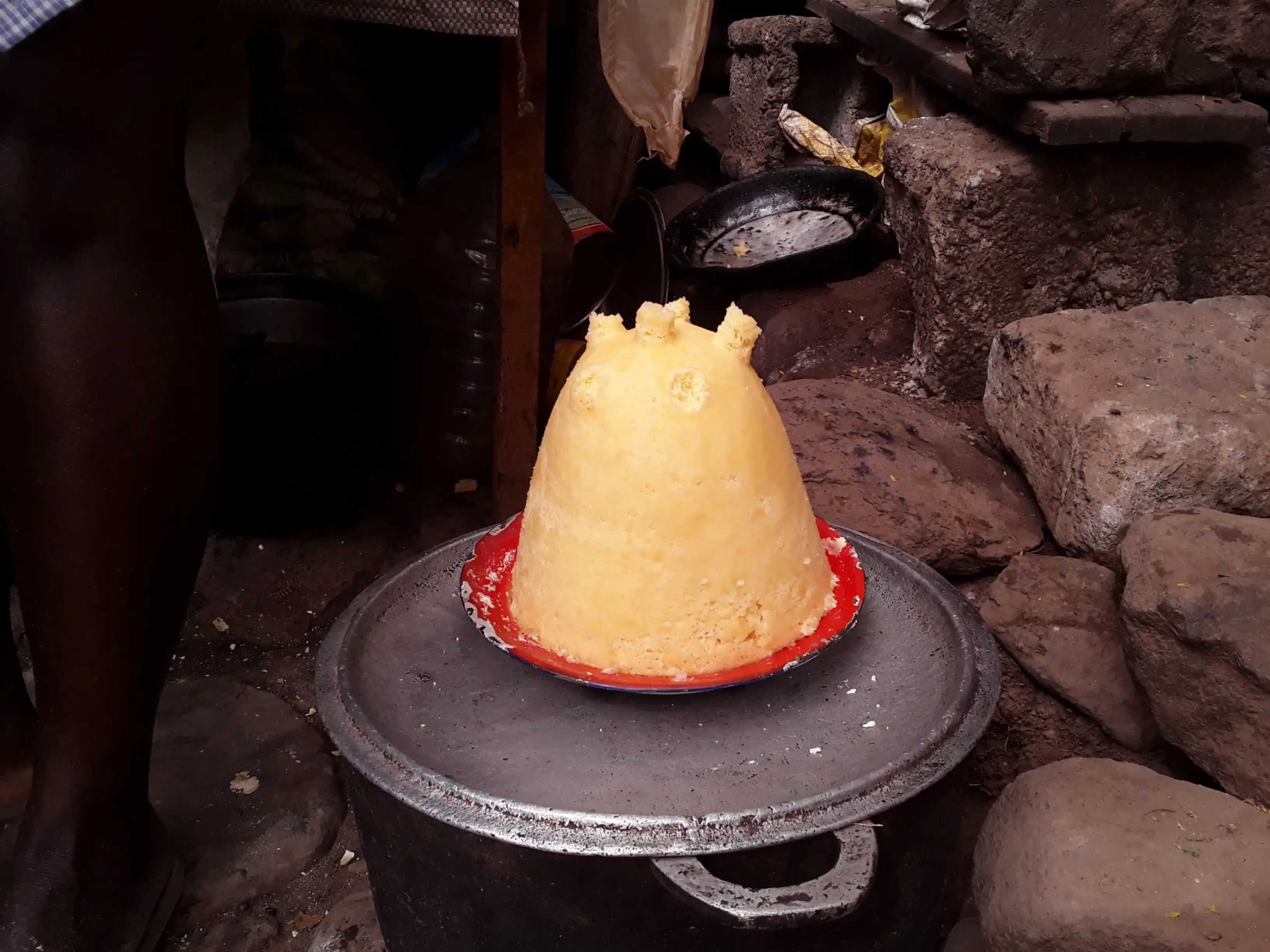
Taking the couscous out of the binde
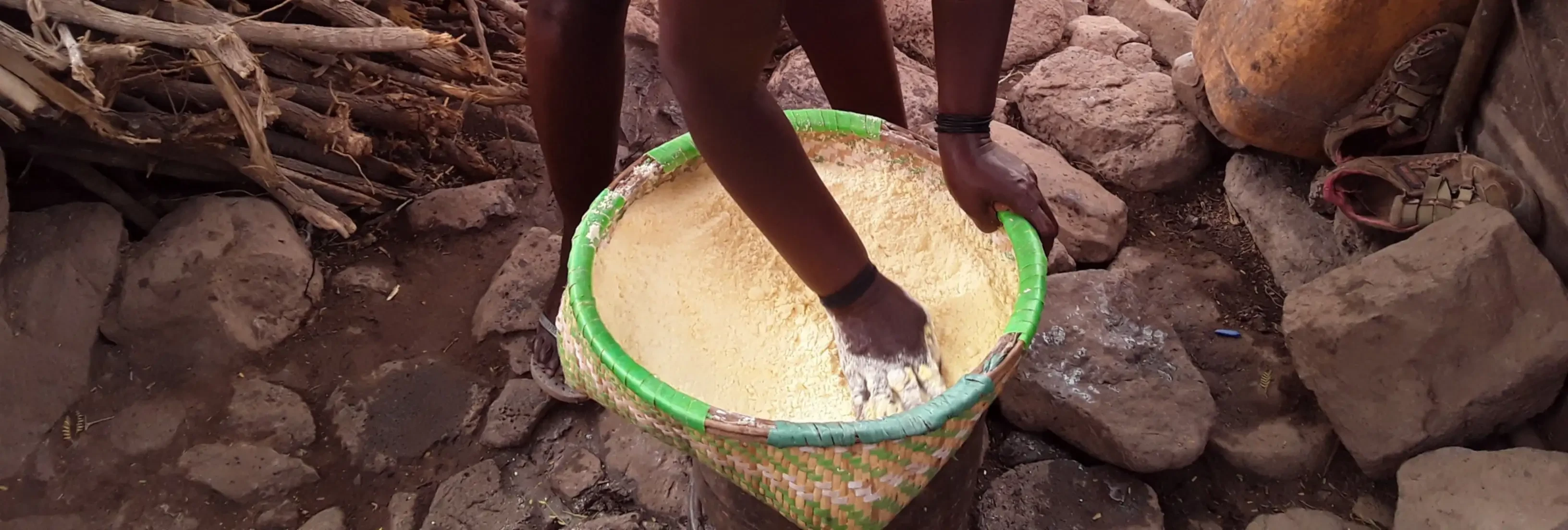
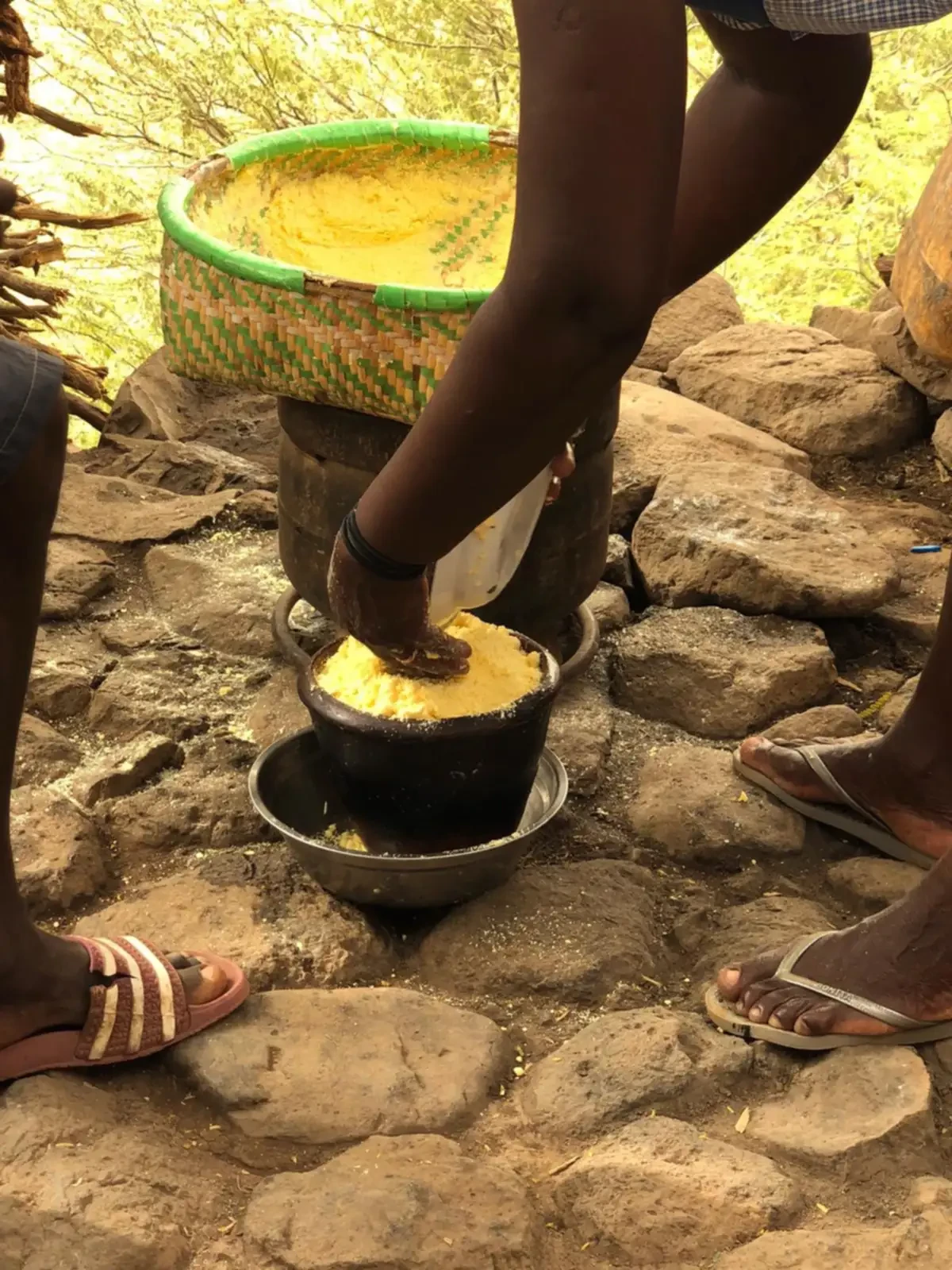
Cape Verdean couscous translates some of the Atlantic transits that make up the country’s history. Very different from the North African one, this couscous is similar to a steamed cake - both in format and consumption. Cooked inside the binde, wolof word likely inherited from the senegalese enslaved people, its warm slices are a perfect match for butter, honey, or milk. Maize or yucca flour take the place of sorghum in this recipe and any flour is used to seal the binde.
Cape Verde was not the first place in which I tried this cake-styled couscous: in Brazil, the ceramic pot with small holes on the bottom is replaced by a pan named cuscuszeira and you can fill it and eat it with many different salty or sweet ingredients. For me, taking it out of the binde was one of those *life-changing wonder-hesitation moments* that can only happen while cooking, in which one is not sure if it will look as good as it smells; if it will hang in there or fall to pieces, if you are about to start it all over again.
Spoilers: you can use a plant pot with holes too; there are many diverse couscous recipes, this is the one I learned.
fine maize flour
water
pinch of salt
sugar (to taste)
cinnamon (to taste)
Start by slowly mixing the flour and the water inside a large bowl or recipient until it reaches a loosen and moist consistency: the consistency is your goal, not specific quantities;
Add the sugar; the salt & the cinnamon;
Mix it again.
Grease your binde (or plant pot) with butter and add your mixture inside.
Meanwhile, boil water in a pot that matches your binde size - it will rest inside this pan, above the boiling water, but must never touch it.
Mix water and any type of flour into a thick paste.
Use this to seal the gaps between the binde and the pan so all steam is going up the top through its holes. Cover the top with a plate and wait for the steam to start coming out through its sides: your couscous is ready.
Marmitako
Paloma Garcia Gonzalez
- snack
- summer
- Basque Country
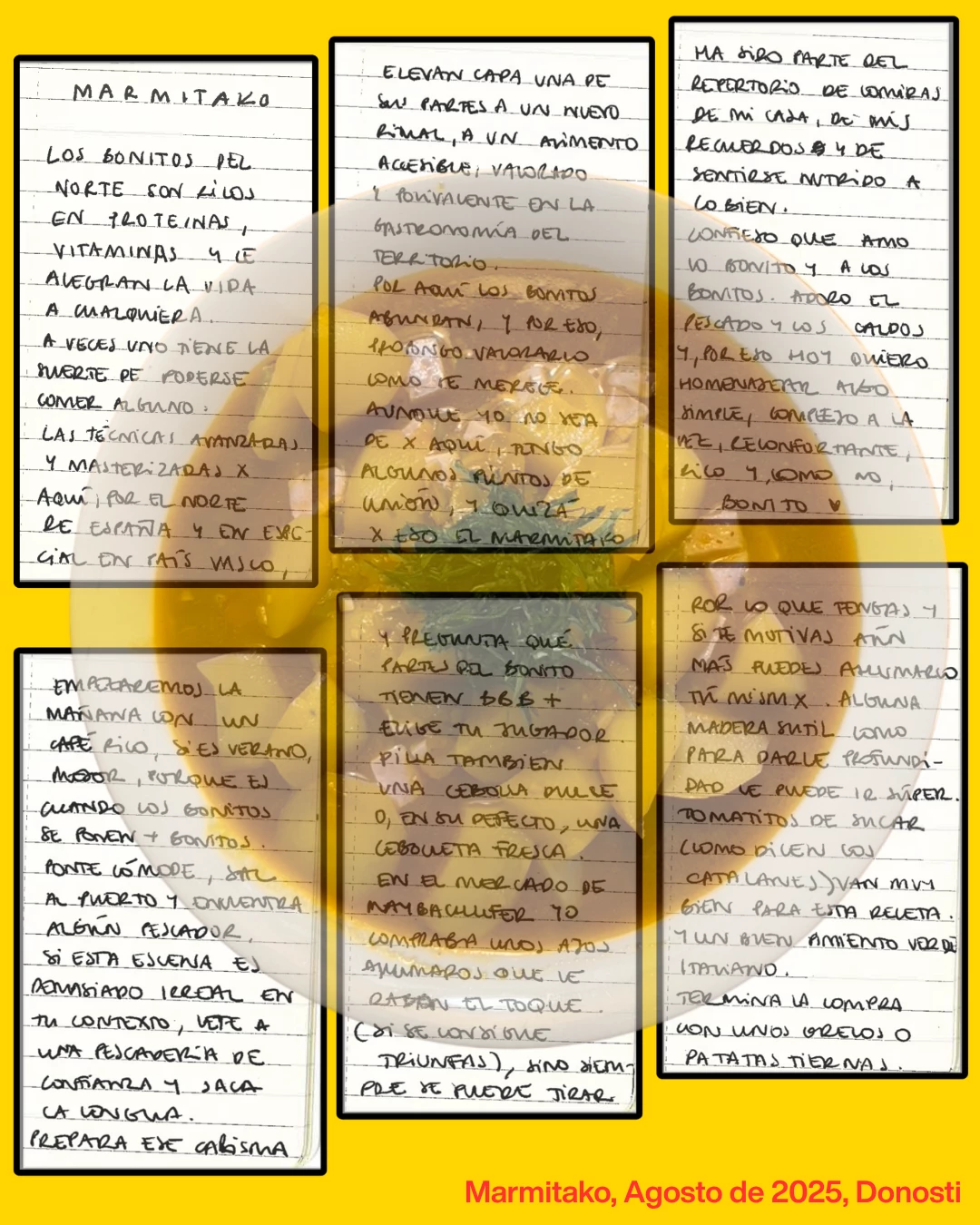
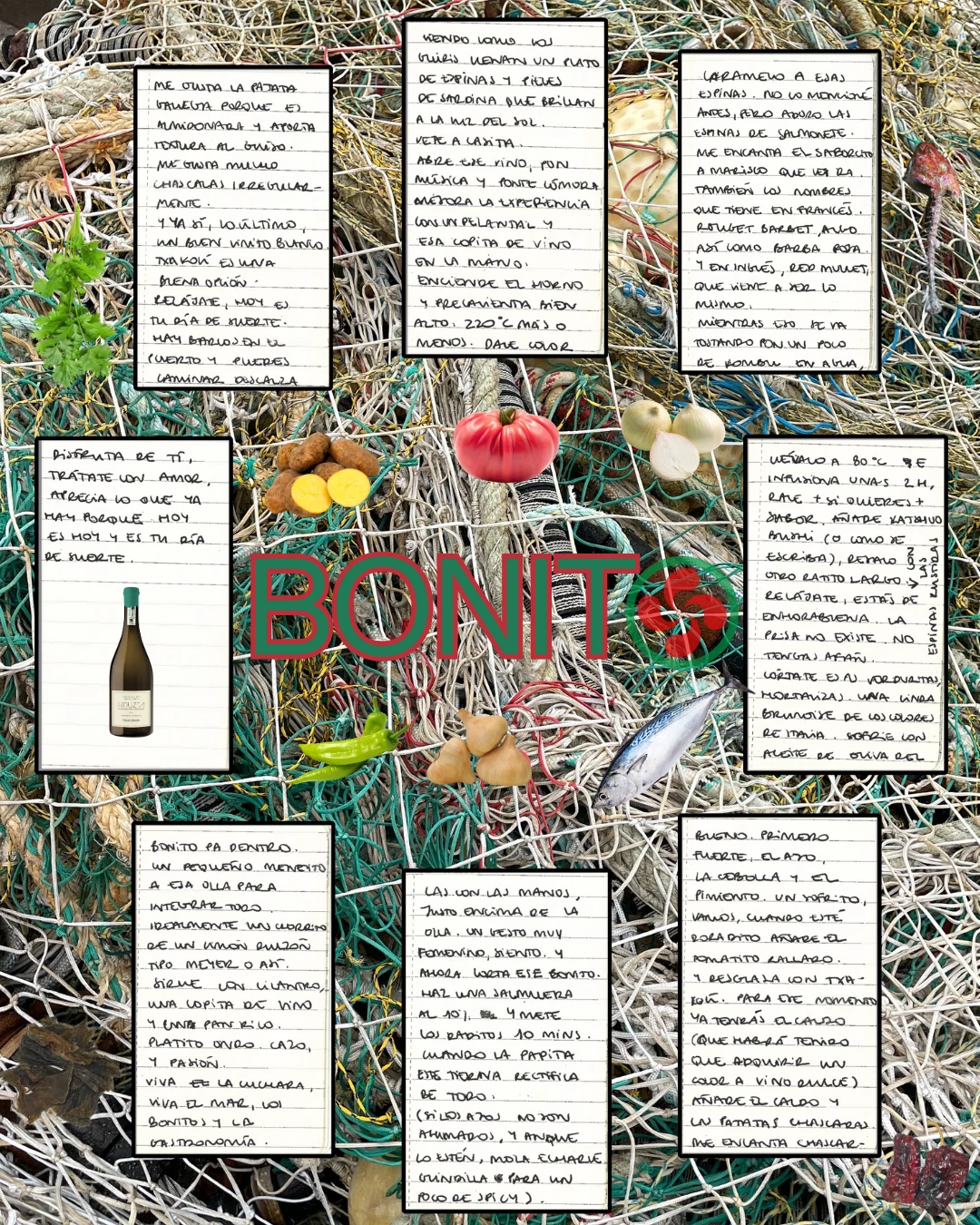
Los bonitos del norte son ricos en proteínas, vitaminas y le alegran la vida a cualquiera. A veces uno incluso tiene la suerte de poder comerse alguno. Las técnicas avanzadas y masterizadas por aquí, por el norte, especialmente las de país vasco, elevan cada una de sus partes a un nuevo ritual. Siendo así un alimento accesible, valorado y polivalente en la gastronomía del territorio. Por aquí los bonitos abundan, y por eso propongo valorarlo como se merece. Aunque yo no sea de por aquí, algo me une, y quizá por eso el Marmitako ha sido parte del repertorio de comidas de mi casa, de mis recuerdos, y de sentirse nutrido a lo bien.
Confieso que amo lo bonito y a los bonitos. Adoro el pescado, y los caldos y por eso hoy quiero homenajear algo simple, complejo a la vez reconfortante, rico y cómo no, bonito.
Empezaremos la mañana con un café rico, si es verano mejor, porque es cuando los bonitos se ponen aun más bonitos. Ponte cómode, sal al puerto y encuentra algún pescador. Si esta escena es demasiado irreal en tu contexto, vete a una pescadería de confianza y saca la lengua. Prepara ese carisma y pregunta qué partes del bonito tienen bueno, bonito, barato. Elige tu jugador. Pilla también una cebolla dulce, o en su defecto una cebolleta fresca. En el mercado de Maybachufer de Berlín, solía encontrar unos ajos ahumados que le daban un toque espectacular, si lo consigues triunfas, pero sino siempre se puede optar por un ajo de los de siempre, o si te motivas puedes hasta ahumarlo tu mismx con alguna madera sutil como para darle profundidad le puede ir súper. Tomatitos de sucar como dicen los catalanes, van muy bien para esta receta, esos se llaman ramillet, o sino uno de caserío muy maduro también va perfecto, y un buen pimiento verde italiano. Termina tu compra con unos grelos o patatas tiernas. Me gusta la patata gallega porque es almidonada y aporta textura al guiso. Me gusta especialmente chascarlas irregularmente justo encima de la olla, como hacen las abuelas. Y ya si, lo último un buen vinito blanco, Txakolí es una gran opción ya que estamos haciendo un plato vasco, es verano y entra genial. Relájate, hoy es tu día de suerte. Hay barcos en el puerto y puedes caminar descalza viendo como los guiris llenan un plato de espinas y pieles de sardina que brillan a la luz del sol. Vete a casita, abre ese vino, pon música y ponte cómoda. Mejora la experiencia con un delantal y esa copita de vino en tus manos.
Enciende el horno y precalienta bien alto, 220 más o menos. Dale color a caramelo a esas espinas. No lo mencioné antes pero adoro las espinas de salmonete, y esas son las que voy a utilizar yo. Me encanta el sabor a marisco que le da. También los nombres en Francés, Rouget Barbet, algo así como barba roja. Y en inglés red mullet, que viene a ser lo mismo. Mientras estas espinas se van tostando, pon un poco de alga Kombu en agua y llévalo a 80 grados, infusiona aproximadamente dos horas sin que llegue a hervir, añade bonito seco Katsuobushi, dejálo con las espinas tostadas un rato a fuego muy bajo. Relájate, estás de enhorabuena, la prisa no existe, no tengas afán. Corta esas verduritas y hortalizas en una linda brunoise de los colores de Italia. Sofríe con aceite de oliva del bueno, primero fuerte el ajo, la cebolla y el pimiento. Un sofrito, vamos. Cuando esté doradito, añade el tomate rayado y desglasa con Txakolí. Para ese momento ya tendrás el caldo (que habrá tenido que adquirir color a vino dulce), añádeselo junto a unas patatas chascadas, con las manos, justo encima de a olla. Un gesto muy femenino, siento. Y ahora corta ese bonito que has comprado, haz una salmuera al 10% de sal y mete los daditos unos 10 minutos. Cuando la patata esté tierna rectifica de todos. A mi me gusta especialmente echarle una guindilla al sofrito para un toque spicy, pero eso va a elección del cocinero. Ahora sí, el bonito para dentro, un pequeño meneo a la olla para integrarlo todo e idealmente un chorrito de un limón dulzon tipo Meyer. Sirve con cilantro, perejil, una copita de vino y un pan rico, que esto está para mojar. Plato hondo, cazo y pasión. Viva la cuchara, viva el mar, los bonitos y la gastronomía. Disfruta de ti, trátate con amor, aprecia lo que hay porque hoy es hoy y es tu día de suerte.
Northern bonito is packed with protein, vitamins, and instantly brightens up anyone’s day. Sometimes, if you’re lucky, you even get to eat one. Up here in the north—especially in the Basque Country—people have seriously mastered the art of bonito, turning each part into a little ritual. It’s everyday food here, sure, but also adored and endlessly versatile in local cuisine. That’s why I say, let’s give bonito the appreciation it deserves. Even though I’m not originally from these parts, something about bonito connects me; maybe that’s why Marmitako was a staple in my home, part of my memories, and a symbol of good, nourishing meals.
Truth be told, I love bonito. I love bonito the fish, and just the whole vibe. I'm crazy about fish in general, and broths, so today’s all about paying tribute to something simple, rich, complex, comforting, and, well… bonito.
We’ll start the morning with a good coffee. Summer’s even better, because that’s when the bonitos get extra bonito. Get comfy, stroll down to the port, and spot a fisherman. If that’s a stretch in your world, just go to a trusty fishmonger and get charming. Ask which parts of the bonito are best—fresh, beautiful, and a bargain. Pick your winner. Grab a sweet onion too, or a spring onion if that’s what you find. Back when I lived near Berlin’s Maybachufer market, I’d hunt down these amazing smoked garlic bulbs—if you can score them, your dish will sing. But regular garlic works just fine, and if you’re feeling ambitious, you can smoke your own over some gentle wood for an extra layer of flavor. Little snacking tomatoes (the Catalans call them ramillet), or any super-ripe farmhouse tomato, pair perfectly here, as does a plump Italian green pepper. Round out your haul with some new potatoes—I love Galician potatoes for their starchy, silky vibe. Best part? Breaking them apart irregularly straight into the pot, just like grandmas do. Last but absolutely not least, a decent bottle of white wine. Txakolí is perfect here: Basque dish, summertime, goes down easy. Relax; today’s your lucky day. Boats in the harbour, walking barefoot, watching tourists pile their plates with sardine bones that glitter in the sun. Head home, pop that wine, cue the tunes, and slip into your comfiest self. An apron and a glass in hand just elevate the whole experience.
Crank up your oven—high, about 220°C (430°F). Roast those fish bones until they’re caramel-brown. I should mention, I’m a sucker for red mullet bones—they bring that extra shellfish punch (plus, ‘Rouget Barbet’ in French sounds fancy). While the bones are roasting, infuse some kombu seaweed in water at 80°C for a couple of hours—don’t boil it. Toss in dried bonito flakes (Katsuobushi), let it hang out with the roasted bones on super-low heat for a while. Take it easy. Today, time doesn’t exist; there’s no rush.
Slice all your veggies into a gorgeous brunoise with the colors of the Italian flag. Sauté in your favorite olive oil—first the garlic, then onion and pepper. Classic sofrito business. Once golden, add grated tomato and deglaze with Txakolí. By now, your broth should be a lovely shade of sweet wine—add it in, along with those hand-snapped potatoes, right over the pot. It’s a gentle, almost feminine gesture, somehow. Now, dice up your bonito, make a 10% salt brine, and let the cubes bathe for ten minutes. When the potatoes are just tender, check everything for seasoning. I love to toss a little chili into the sofrito for some extra kick, but that’s chef’s choice. Finally, in goes the bonito. Give the pot a gentle wiggle to mix it all, and, ideally, a squeeze of sweet Meyer lemon. Serve with cilantro, parsley, a glass of wine, and really good bread, because this sauce begs for dunking. Deep bowls, a good ladle, and plenty of heart. Long live the soup spoon, the sea, bonito, and good eating.
Enjoy yourself, be kind to you, celebrate what’s on hand—because today is today, and today’s your lucky day.
Recipe for Toast with Variations
Rebecca Cosenza
- diaspora
- snack
- Jamaican
Re-ordered recollection of stories à table with my great-auntie, who grew up in Jamaica in the 30s and found her way to a canton in the Jura hills, and my mama, who left the island in the 80s and married an Italian-American.
They both begin their day with a slice of toast for breakfast.
Recipe for Toast with Guava Jelly:
- guavas
- sugar
- water
- lime juice
When she comes to visit, I make her guava jelly. Very ripe guavas, enough water to cover the fruit. Boil until the guavas are tender and you thought to plant roses, but I won’t be around to help in the garden. Remember she would eat otaheite apples till she was sick, and her mama’s mama would mix the pickapeppa with the tinned corn beef to bring to the beach.
The traditional way of straining the guavas is to tie a muslin cloth to the legs of an upturned chair. The contents of the pot are poured into the muslin and the juice drips through and is caught by a bowl placed underneath it. 30 minutes pass, so I bring you peonies and then send her a picture of you with the peonies and an empty garden. Light the candles to save the apricots, she tells me. I’ll mourn your orchids in Geneva.
One cup of juice to one cup of sugar. One lime for every 3 cups of liquid. Or so they say. She sewed her wedding dress from a tablecloth and her daddy counted all the sugar that left Jamaica on an abacus. Return the mixture to the pan and boil vigorously, stirring occasionally, until small bubbles begin to appear. Let it cool slightly, then pour into jars. Often, accidentally, I will make enough for one jar of guava jelly to match the silk tacked to the edges of the window frame, red orange shadow to make you look sunburnt in the early morning.
Serve with bread, double toasted. Butter on the side. Pairs well with black tea and milk, or ginger tea.
Adaptation of page 196, Traditional Jamaican Cookery by Norma Benghiat
Ginger Tea
- ginger
- water
- honey
Cut the ginger, boil in water for a long time. Let cool and settle.
Option to water down depending on how spicy and sweeten to taste.
We sit outside the doctor's office and put our lipstick on, clip our hair. Listen to the blood pass; make a new artery by walking.
Hardo Bread Variation
Still image. You table me.
Pewter plate, mother of pearl spoon.
You wash my hair in the sink,
Blow dry the letter’s ink.
Khus Khus on the counter.
Hardo toast buttered to remember the
feeling of her mother’s affection.
Forgive me it was delicious
To eat in bed.
Panettone Variation
Toast the panettone
In a cast iron pan.
Heat the beef patty.
Place the patty on top of the panettone,
Eat together.
Where did you come from?
How did you arrive?
How will you begin?
These Americans, they’re really weird. How can they eat mustard like that. It must have gotten lost in translation somewhere between Patwa (abandoned) and Italian (acquired through unknown means).
Hoppin' John
Yemisi Oyeniyi
- diaspora
- new year
- one-pot
Hi this is Yemisi and I'm gonna share two versions of Hoppin’ John. Hoppin’ John is an African-American dish made with Black-eyed peas served alongside pork, greens and cornbread on the first day of the new year as the good luck meal, which is, to bring abundance, wealth, good health, and all the good things. Black-eyed peas were brought to the Americas by enslaved Africans during the transatlantic slave trade and cultivated throughout the south-eastern part of the United States. Hoppin’ John is thought to originate in the Carolinas and the sea Islands off of Georgia. In my family, we did eat Black-eyed peas. We didn't eat it mixed with the rice but I have in the last 20 years or so found that I have been mixing the Black-eyed peas with the rice in my preparations, and not always in the classic form, but in different forms and I can say each version is different. So sometimes I use the black Chinese rice and sometimes just the Carolina rice and the two versions I'm gonna share are both with the Carolina gold rice, which is a rice that Africans brought over when they made the middle passage. So yes, one of the recipes is with canned peas and the other is with dried peas.
So the first one is 1 cup of Carolina golden rice, 1 can of coconut milk, 2 cans of Black-eyed peas, 1 onion chopped, ½ Portuguese sausage diced, 3 ½ cups of water, 2 to 3 garlic cloves minced. Sauté the onion, the garlic, the sausage in a pot with grapeseed oil until soften. Add the Black-eyed peas and sauté a little more. Blend in the coconut milk and bring to a boil. Add the rice and water, simmer without a cover and stir until the rice is cooked (for) about 20 minutes.
The second version uses a ½ a pound of dry Black-eyed peas which you soak in water for 12 hours, 1 medium chopped onion, 2 garlic cloves finally chopped, 3 to 5 springs of thyme, 1 bayleaf, olive oil, 1 cup of red wine, 1 cup of chicken broth, 2 cups of water, 1 cup of golden Carolina rice, 1/2 a cup of black coffee, and 2 tablespoons of cognac or brandy.
Drain and rinse the peas and set aside. In a pot heat 1/4 cup of olive oil and sauté the onions and garlic until translucent. Add the peas, the wine and the broth, the water, the thyme, a pinch of hot pepper flakes and the bayleaf. Bring to a boil. Lower to simmer, cover and cook for one hour or so until the peas are soft to chew. Then add a cup of rice, stir and cook (for) 20 minutes or so until the rice is done. Right before serving like 5 to 10 minutes before at the coffee and the cognac and if you feel up to it toss in some chopped ham. Enjoy and be inspired.